Federal Architecture and Urban Landscapes: How Neoclassical Design Shapes American Cities
 Jun, 22 2026
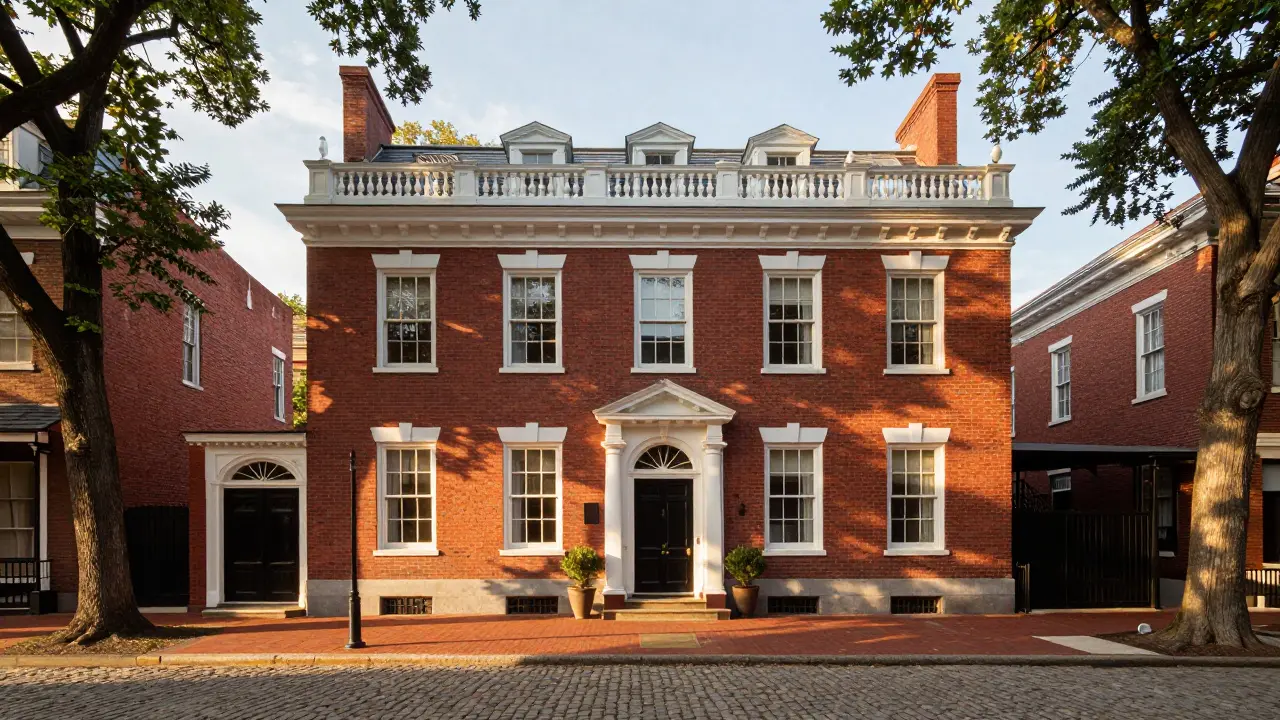
Walk down Pennsylvania Avenue in Washington, D.C., or stroll through the historic district of Charleston, South Carolina. You notice a pattern. The buildings are symmetrical. They have brick facades with white trim. There are grand entrances framed by columns or pilasters. This isn’t just coincidence; it is the lingering footprint of Federal architecture, a style that dominated the early United States from roughly 1780 to 1830. But why does this specific aesthetic matter today? It matters because Federal architecture didn’t just house people; it defined how early Americans viewed their new republic. It shaped the physical layout of our cities, established visual hierarchies in public spaces, and created a sense of order that still influences urban planning decisions two centuries later.
When we talk about the impact of Federal architecture on urban landscapes, we aren't just discussing old houses. We are looking at how a design philosophy rooted in democracy and classical antiquity physically structured the growing nation. From the placement of capitol buildings to the grid-like expansion of residential neighborhoods, this style left an indelible mark on the American city.
The Birth of a National Aesthetic
To understand the landscape, you first need to understand the mindset. After breaking away from Britain, American leaders wanted a visual identity that was distinct from the ornate Rococo styles associated with European monarchies. They looked back further-to ancient Greece and Rome. These civilizations were seen as the birthplaces of democracy and republicanism. Neoclassicism became the vehicle for this political statement.
Federal architecture is the American iteration of this movement. It is lighter and more refined than its British Georgian predecessor. Think of delicate fanlights over doors, elliptical arches, and low-pitched roofs with balustrades instead of heavy cornices. Architects like Charles Bulfinch and Benjamin Henry Latrobe championed this style. They weren't just designing buildings; they were designing a civic religion. The goal was to create environments that inspired citizens to behave with dignity and respect for the law.
This shift had immediate consequences for urban form. Cities needed centers that reflected this new ideal. That meant moving away from chaotic, organic medieval street patterns toward planned, geometric layouts centered around monumental public squares and government buildings.
Civic Centers and the Power of Symmetry
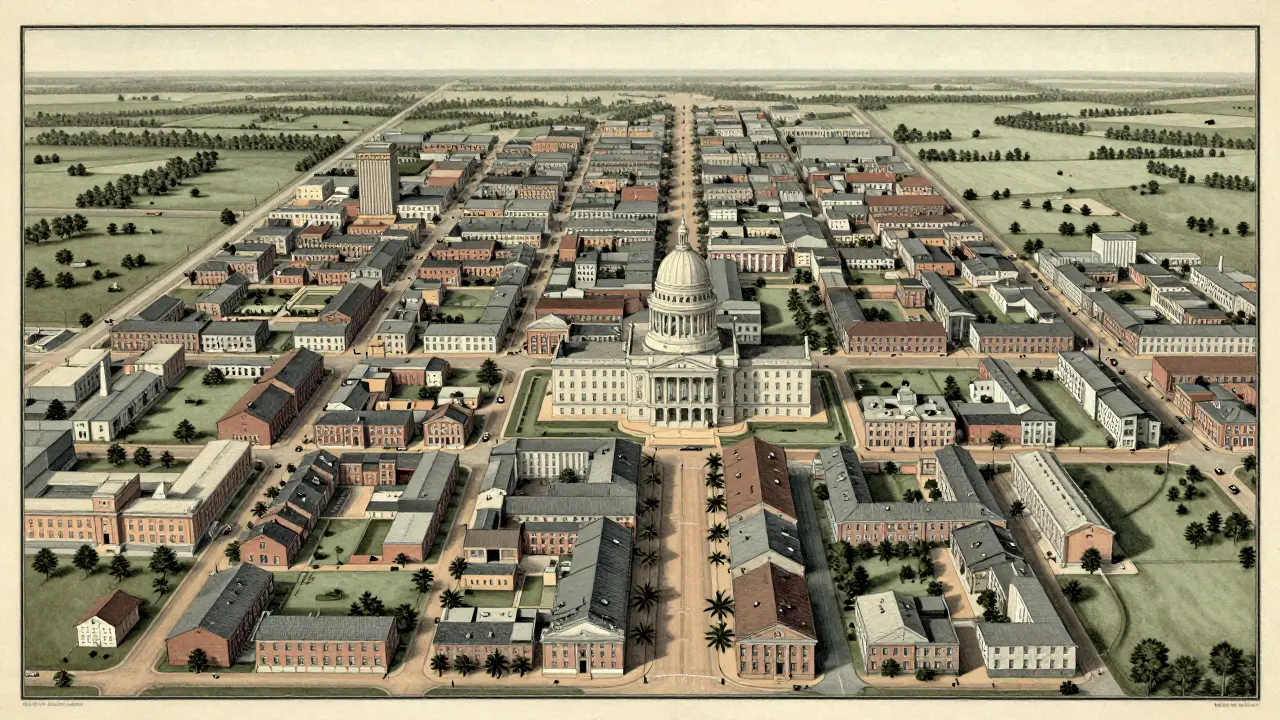
The most visible impact of Federal architecture on urban landscapes is found in civic centers. In the late 18th century, towns across the Atlantic seaboard began rebuilding their courthouses and town halls. These structures became the anchors of their communities. Take Boston’s Faneuil Hall, expanded during this period, or the various state capitols being constructed in the 1790s. These buildings demanded space. They required wide avenues leading up to them, creating natural focal points in the urban fabric.
Symmetry was king. A Federal building looks best when viewed head-on, emphasizing balance and stability. Urban planners responded by aligning streets to frame these structures perfectly. If you look at maps of cities like Richmond, Virginia, or Philadelphia, Pennsylvania, you can see how major thoroughfares were adjusted or widened to provide unobstructed views of these civic monuments. This practice established a precedent: important buildings should dominate the skyline and command the surrounding streetscape.
Consider the U.S. Capitol Building in Washington, D.C. Although construction spanned decades and styles evolved, its initial design by William Thornton and subsequent work by Latrobe and Bulfinch set the template for national authority. The dome and wings created a massive complex that dictated the scale of the entire capital city. Surrounding blocks had to match its grandeur, influencing zoning laws and height restrictions that persist in some form today.
| Feature | Urban Impact | Example Location |
|---|---|---|
| Brick Facades with White Trim | Created uniform, cohesive streetscapes in residential districts | Charleston, SC Historic District |
| Palladian Windows & Fanlights | Added vertical emphasis, allowing taller structures without overwhelming neighbors | Mt. Vernon Place, Baltimore |
| Low-Pitched Roofs with Balustrades | Reduced visual bulk, enabling denser urban infill while maintaining light access | Georgetown, Washington D.C. |
| Central Entrances with Pediments | Defined primary axes for street planning and pedestrian flow | Independence Hall, Philadelphia |
Residential Neighborhoods and Social Order
Beyond government buildings, Federal architecture profoundly shaped where and how people lived. As the young nation grew wealthy through trade and agriculture, a new class of merchants and professionals emerged. They wanted homes that signaled their status but also adhered to the republican virtue of modesty compared to aristocratic estates.
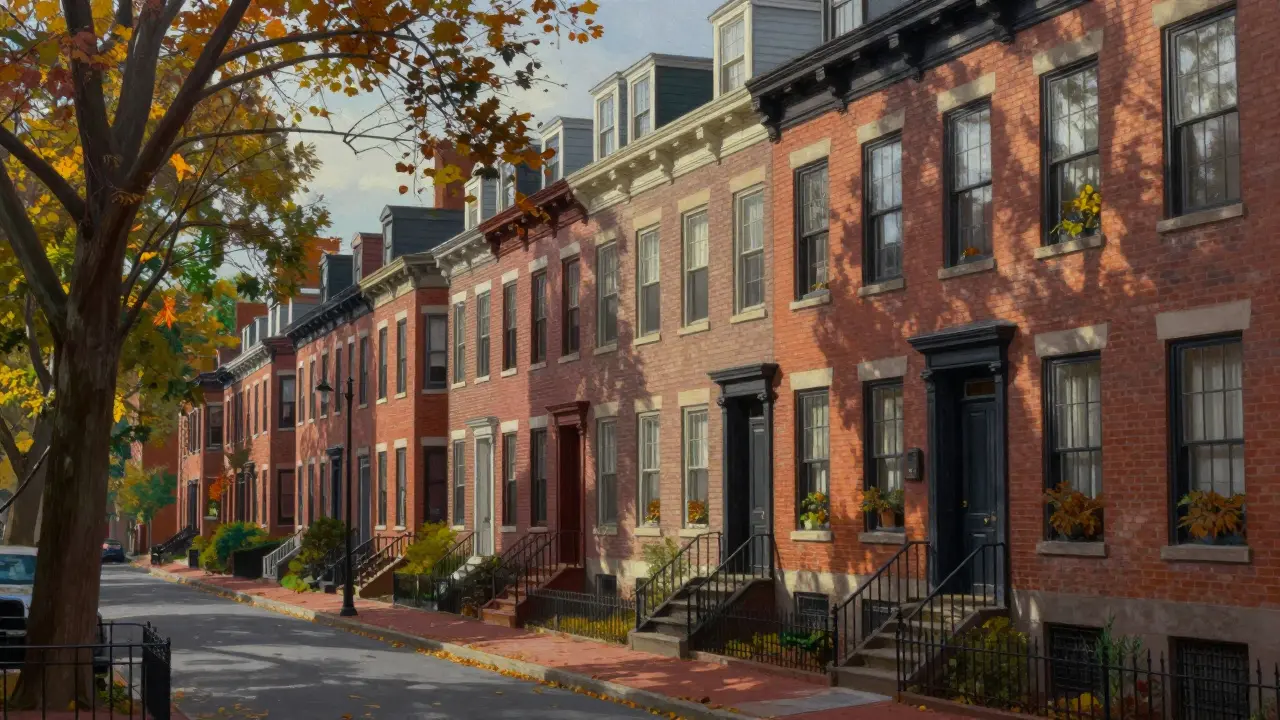
This led to the development of row houses and townhouses in dense urban cores. In cities like New York and Boston, narrow lots were filled with multi-story brick homes featuring side-hall plans. These designs maximized interior space while presenting a unified facade to the street. The result was a continuous wall of brick along sidewalks, which created a strong sense of enclosure and safety-a concept modern urbanists still value.
Look at Beacon Hill in Boston. Built largely between 1800 and 1850, it features red-brick Federal-style townhouses arranged on steep hillsides. The architecture dictated the topography. Streets were carved into the hill, following contours but maintaining alignment with the buildings' frontages. This integration of built form and natural terrain influenced later suburban developments, proving that even constrained urban sites could accommodate elegant, orderly living.
Furthermore, Federal residential design encouraged walkability. Because these homes were often located near commercial centers and churches, residents didn't need carriages for daily errands. The compact nature of Federal-era neighborhoods fostered vibrant street life, with porches and stoops serving as semi-public spaces for social interaction. This human-scale environment contrasts sharply with the sprawling, car-dependent suburbs that would dominate the 20th century.
Material Culture and Local Adaptation
One might assume Federal architecture looks identical everywhere, but local materials forced creative adaptations. In the Northeast, where clay was abundant, brick became the standard. Builders developed sophisticated techniques for laying brick in Flemish bond patterns, adding texture and depth to otherwise plain walls. Lime mortar allowed for fine detailing around windows and doors.
In contrast, Southern cities like Savannah and Charleston relied heavily on wood due to plentiful timber resources. Here, Federal architecture manifested as wooden frame houses with clapboard siding painted white or pastel colors. These structures featured wider eaves and deeper porches to combat heat and humidity. Despite material differences, the underlying principles remained: symmetry, proportion, and classical references.
This regional variation enriched the national landscape. Instead of a monolithic style, Americans saw a diverse expression of shared values. A traveler moving from Maine to Georgia would recognize the Federal language but appreciate local dialects. This flexibility helped the style endure beyond its peak popularity, influencing Revival movements well into the 19th and 20th centuries.
Legacy in Modern Urban Planning
Today, few new buildings are designed in strict Federal style. Yet, its influence permeates contemporary urban design. Many historic preservation societies fight to protect Federal-era districts because they represent authentic American heritage. But beyond nostalgia, there are practical lessons embedded in these landscapes.
Modern planners study Federal cities to learn about density and diversity. These neighborhoods mixed housing types-single-family homes above shops, apartments behind main houses-creating economically varied communities. Today’s “missing middle” housing advocates point to Federal row houses as models for increasing urban density without sacrificing character.
Additionally, the emphasis on public space remains relevant. Federal architects understood that buildings don't exist in isolation; they interact with plazas, parks, and streets. Contemporary projects aiming to revitalize downtown areas often mimic this approach, placing civic buildings at intersections or overlooking green spaces to encourage community engagement.
Even infrastructure reflects this legacy. Early road networks designed to showcase Federal landmarks laid the groundwork for modern arterial systems. While traffic volumes have exploded, the basic skeleton of many American cities still follows those original alignments. Changing them now would be prohibitively expensive and disruptive, locking in the spatial logic of the early republic.
Challenges and Preservation Efforts
Preserving Federal architecture poses unique challenges. Brick deteriorates over time, requiring specialized masonry skills to repair. Wood rot affects Southern examples, demanding constant maintenance. More critically, changing economic pressures threaten these structures. High land values incentivize demolition for larger, more profitable developments.
However, adaptive reuse offers hope. Old Federal banks become boutiques. Former townhouses turn into boutique hotels or co-working spaces. By repurposing these buildings, cities retain their historical charm while meeting modern needs. Organizations like the National Trust for Historic Preservation play a crucial role in identifying and protecting significant sites.
Education is another key factor. Teaching future architects and planners about Federal principles ensures that new constructions respect existing contexts. When developers propose additions to historic districts, guidelines based on Federal aesthetics help maintain visual continuity. This balance between innovation and tradition keeps urban landscapes dynamic yet coherent.
What defines Federal architecture?
Federal architecture is characterized by symmetry, refined proportions, and classical details such as fanlights, Palladian windows, and balustrades. It uses brick or wood facades with minimal ornamentation, reflecting Enlightenment ideals of reason and order. Popular from 1780 to 1830, it replaced the heavier Georgian style and preceded the Greek Revival.
How did Federal architecture influence city planning?
It promoted geometric street grids, wide boulevards leading to civic centers, and dense residential neighborhoods with uniform facades. Planners used symmetry to highlight important buildings, creating clear visual hierarchies. This approach established enduring patterns for urban growth and public space organization.
Where can I see good examples of Federal architecture?
Major concentrations exist in Washington, D.C. (White House, Capitol), Boston (Beacon Hill, Faneuil Hall), Philadelphia (Independence Hall area), Charleston, SC, and Baltimore, MD. Smaller towns along the East Coast also feature well-preserved Federal-era courthouses and homes.
Why is Federal architecture considered democratic?
Its inspiration from ancient Greek and Roman republics symbolized liberty and citizen participation. Unlike royal palaces, Federal buildings emphasized accessibility and rationality. Their restrained elegance avoided ostentatious displays of wealth, aligning with revolutionary values of equality and civic virtue.
Is Federal architecture still relevant today?
Yes, through preservation efforts and adaptive reuse. Its principles of human-scale design, mixed-use density, and prominent public spaces inform modern sustainable urbanism. Additionally, understanding Federal layouts helps historians and planners manage historic districts effectively.