Constructivist Architecture: Where Radical Innovation Meets Bold Aesthetics
 Jul, 11 2026
Imagine a building that doesn't just sit on the ground but seems to defy gravity, exposing its skeleton of steel and glass like a machine in motion. This is the world of Constructivist architecture, a movement that refused to hide behind decorative facades or historical references. Born from the ashes of the Russian Revolution, this style didn't just change how buildings looked; it changed what buildings were allowed to be.
You might think of architecture as static-walls, roofs, foundations. But for the Constructivists, a building was a social tool, a dynamic entity designed to serve the collective. They stripped away the ornamentation of the past to reveal the raw beauty of structure itself. Today, looking back at these structures, we see more than just concrete blocks. We see a radical intersection where engineering innovation met a stark, powerful aesthetic that still influences modern design.
The Birth of a New Visual Language
To understand why Constructivist architecture looks the way it does, you have to look at the chaos it emerged from. In the early 1920s, Russia was undergoing a massive societal shift. The old aristocratic order was gone, replaced by a new communist state that needed new symbols. Architects like Vladimir Tatlin, Alexander Rodchenko, and the brothers Viktor and Leonid Vesnin asked a simple question: Why should a factory look like a palace?
They decided it shouldn't. Instead, they turned to the language of industry. If the future belonged to the worker and the machine, then buildings should reflect that reality. This led to the adoption of "primary forms"-cubes, spheres, and cylinders. These weren't chosen because they were pretty; they were chosen because they were efficient and honest. A cube is a cube. It doesn't pretend to be anything else. This honesty became the core aesthetic principle of the movement.
The visual impact was immediate and shocking. Buildings featured exposed structural elements, asymmetrical compositions, and a lack of traditional symmetry. The goal was to create a sense of movement and tension. You walk past a Constructivist tower, and it feels like it's leaning into the wind, ready to launch. That feeling of kinetic energy was intentional. It was supposed to mirror the rapid pace of social change happening outside those walls.
Innovation Through Industrial Materials
Aesthetics alone don't make a movement revolutionary; technology does. Constructivist architects were among the first to fully embrace new industrial materials, particularly reinforced concrete, steel, and glass. Before this era, these materials were often hidden behind brick or stone cladding. The Constructivists threw off the mask.
Reinforced concrete allowed for cantilevers that seemed impossible just a decade earlier. Imagine a balcony extending out from a tower without visible support below. This wasn't just a design flourish; it was a demonstration of structural capability. Steel frames enabled larger spans and thinner walls, allowing for more light and air. Glass became a primary material, not an accent. The famous Palace of Soviets proposal (though never built) envisioned a spiraling tower topped with a rotating statue of Lenin, showcasing how far they were willing to push engineering limits.
This focus on materials created a specific texture in their work. The roughness of unfinished concrete, the sleekness of steel beams, the transparency of glass-all these elements were left visible. This approach, known as "truth to materials," meant that every component of the building had to justify its existence through function or form. There was no room for wasted space or decorative moldings. Every line served a purpose.
The Role of Engineering in Design
In many architectural traditions, the engineer and the architect are separate roles. In Constructivism, they were partners. The structural system wasn't just a support mechanism; it was the primary driver of the aesthetic. The rhythm of columns, the slope of a roof, the placement of windows-all were dictated by how the building stood up. This integration of engineering and art created a unique visual language where logic and beauty were inseparable.
Consider the Tatlin Tower. While it remained a model, its design relied on a twisted double-helix steel structure that would have rotated at different speeds. The aesthetics were directly derived from the mechanical requirements. The building was a machine for living, working, and propagating ideology, all wrapped in a single, cohesive structural concept.
Social Function Over Individual Expression
Here is where Constructivist architecture differs sharply from most Western modernism. While movements like the International Style focused on universal efficiency, Constructivism was deeply political. The buildings were designed to shape behavior and foster community. They weren't just shelters; they were instruments of social engineering.
One of the most fascinating examples of this is the concept of the "House-Commune." These were residential buildings designed to eliminate private domestic labor. Kitchens were communal, dining areas were shared, and even sleeping quarters were sometimes arranged to encourage interaction. The idea was to free women from household chores so they could participate in the workforce. The architecture itself enforced this new way of living.
Moisei Ginzburg, a key theorist of the movement, argued that space should be flexible and adaptable. He introduced the concept of "flowing space," where rooms weren't rigidly defined by walls but by furniture and partitions. This allowed a single area to serve multiple functions throughout the day-a classroom in the morning, a theater in the evening. This flexibility required innovative floor plans and open structures, pushing the boundaries of what residential architecture could do.
Key Examples of Constructivist Masterpieces
While many Constructivist projects were never built due to political shifts and resource shortages, several survive today as testaments to the movement's power. Let's look at three iconic examples that demonstrate the intersection of innovation and aesthetics.
| Building Name | Location | Architect(s) | Key Feature |
|---|---|---|---|
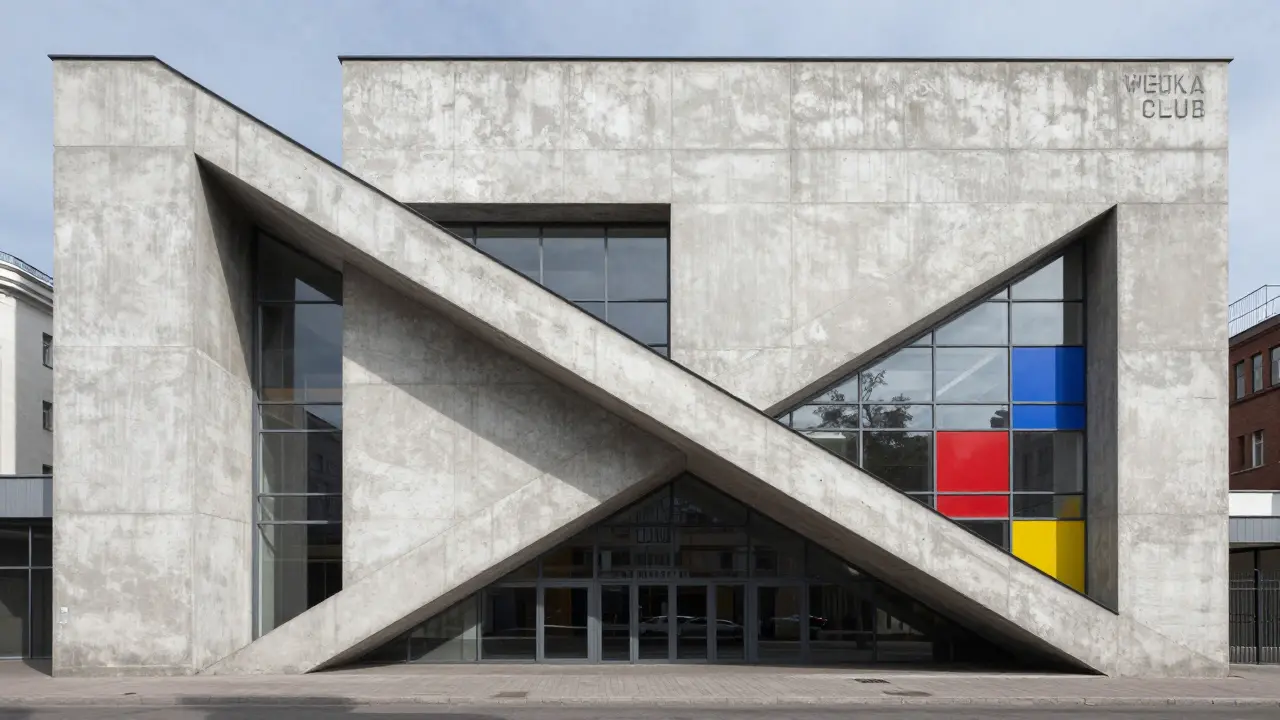
| Rusakov Workers' Club | Moscow, Russia | Vladimir Tatlin, Moisei Ginzburg | Dramatic diagonal ramp slicing through the facade |
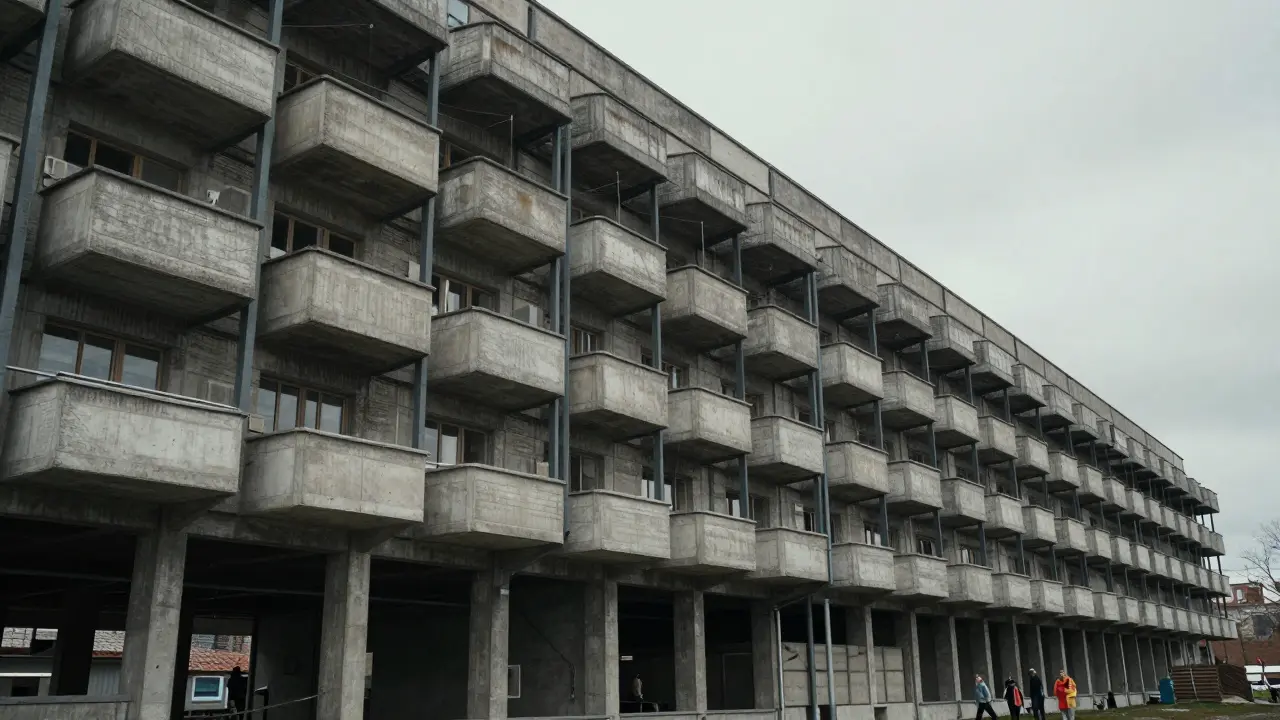
| Narkomfin Apartment Building | Moscow, Russia | Viktor Vesnin, Ignaty Milinis | First use of communal kitchens and balconies as extensions of living space |
| Zuev Workers' Club | Moscow, Russia | Konstantin Melnikov | Asymmetrical composition with a massive projecting stage |
The Rusakov Workers' Club is perhaps the most visually striking example. Its facade features a bold, diagonal concrete ribbon that cuts across the building, symbolizing the forward momentum of the proletariat. Inside, the space is organized around a central hall that can be transformed for various events. The use of color-red, blue, and yellow-was also significant, drawing from the broader Constructivist art movement to create an energetic atmosphere.
The Narkomfin Building offers a quieter but equally important lesson. Designed as a prototype for communal living, it features long corridors lined with small apartments. The balconies project outward, creating a rhythmic pattern along the facade. More importantly, the building includes shared facilities like a laundry, library, and cafeteria. This design reduced the size of individual units while increasing the quality of life through shared resources. It was a practical application of socialist ideals in architectural form.
Konstantin Melnikov's Zuev Workers' Club showcases his personal flair within the Constructivist framework. The building has a distinct, almost sculptural quality, with a large, cantilevered stage that juts out dramatically. The interior is dark and moody, using light and shadow to create a theatrical experience. Melnikov proved that Constructivism could accommodate individual artistic expression while still adhering to its core principles of functionality and social purpose.

The Decline and Legacy of Constructivism
By the late 1930s, Constructivism was effectively banned in the Soviet Union. Stalin's rise to power brought with it a preference for monumental, neoclassical architecture that projected stability and tradition. The radical experiments of the 1920s were deemed too chaotic and ideologically suspect. Many Constructivist architects were purged, and their works were neglected or demolished.
However, the ideas didn't disappear. They traveled west, influencing the Bauhaus in Germany and the International Style in America. Le Corbusier, though not a Constructivist himself, adopted many of their principles, such as the use of pilotis (columns) and free facades. The emphasis on functionalism, minimalism, and the honest expression of structure became the foundation of modern architecture worldwide.
Today, we are seeing a resurgence of interest in Constructivist architecture. Conservation efforts in Moscow and other cities have restored many of these buildings, recognizing their cultural significance. Moreover, contemporary architects are revisiting the movement's ideas about sustainability, communal living, and adaptive reuse. In an era of climate crisis and urban density, the Constructivist focus on efficiency and social cohesion feels remarkably relevant.
Why Constructivism Still Matters Today
So, why should you care about a movement that ended nearly a century ago? Because Constructivist architecture challenges us to think differently about our built environment. It asks us to consider not just how a building looks, but what it does. How does it affect the people who use it? How does it respond to technological possibilities? How does it reflect our values?
In a world increasingly dominated by generic glass boxes and superficial aesthetics, Constructivism reminds us of the power of intentionality. It shows us that architecture can be a force for social change, that materials can speak truth, and that innovation and beauty are not mutually exclusive. When you next see a building with exposed steel beams or a dramatic cantilever, remember the Constructivists. They were the ones who dared to show us the bones of the city.
What is the main difference between Constructivism and Modernism?
While both movements emphasize function and reject ornament, Constructivism is deeply rooted in political ideology and social engineering, specifically aiming to serve the collective worker in post-revolutionary Russia. Modernism, particularly the International Style, tends to focus more on universal efficiency, standardization, and aesthetic purity, often detached from specific political agendas.
Who were the key figures in Constructivist architecture?
Key figures include Vladimir Tatlin, known for his theoretical models like the Monument to the Third International; the Vesnin brothers (Viktor, Alexander, and Leonid), who designed numerous public buildings; Moisei Ginzburg, a leading theorist who wrote extensively on the social role of architecture; and Konstantin Melnikov, whose work added a distinctive sculptural quality to the style.
Are there any surviving Constructivist buildings I can visit?
Yes, several notable examples remain, primarily in Moscow. The Narkomfin Apartment Building, the Rusakov Workers' Club, and the Zuev Workers' Club are well-preserved and accessible. Some have been converted into museums, galleries, or cultural centers, allowing visitors to experience the original spatial dynamics firsthand.
How did Constructivism influence contemporary architecture?
Constructivism influenced contemporary architecture through its emphasis on structural honesty, the use of industrial materials, and the concept of flexible, multi-functional spaces. Many modern architects draw inspiration from its bold geometric forms and its approach to integrating social infrastructure into residential design, particularly in projects focused on communal living and sustainability.
Why was Constructivism banned in the Soviet Union?
Constructivism was banned in the late 1930s under Joseph Stalin, who favored Socialist Realism and neoclassical styles that projected stability, tradition, and imperial grandeur. The radical, experimental nature of Constructivism was seen as too abstract and ideologically inconsistent with the regime's desire for monumental, easily understood symbols of state power.