Constructivist Architecture: The Science, Materials, and Legacy of a Radical Movement
 Aug, 3 2026
Imagine a building that doesn't just sit on the ground but seems to defy gravity, twisting toward the sky like a giant helix made of glass and steel. This isn't science fiction; it is the legacy of Constructivist architecture, a movement that emerged in Russia between 1915 and 1935. It was not merely an aesthetic choice. It was a political and scientific manifesto. The architects behind this style believed that art should serve production and that buildings should reflect the machinery of the modern world.
Unlike the ornate palaces of the past or the sterile boxes of later modernism, Constructivism celebrated the raw power of industry. It asked a radical question: What if we designed cities based on the logic of factories rather than the traditions of kings? The answer reshaped urban planning, material science, and how we perceive space today.
The Birth of a New Visual Language
To understand Constructivism, you have to look at the chaos of post-revolutionary Russia. After the Bolshevik Revolution of 1917, the old order collapsed. Artists and architects felt a urgent need to build a new society from scratch. They rejected "art for art's sake." Instead, they embraced Vladimir Tatlin's concept of "cultural materialism". This meant treating wood, metal, and glass not as decorative elements, but as structural truths.
The movement split into two main camps early on. One group, led by figures like Alexander Rodchenko, focused on pure abstraction and propaganda posters. The other, which included architects like Vladimir Mayakovsky (who collaborated closely with designers) and the Vesnin brothers, applied these principles to physical structures. They wanted to create environments that actively shaped human behavior toward collectivism and efficiency.
This wasn't just about looking cool. It was about function. A Constructivist building was supposed to be a machine for living, working, and propagating socialist ideals. The geometry was sharp, angular, and dynamic. Curves were rare unless they served a specific aerodynamic or structural purpose. Every line had a job.
Tatlin's Tower: The Unbuilt Icon
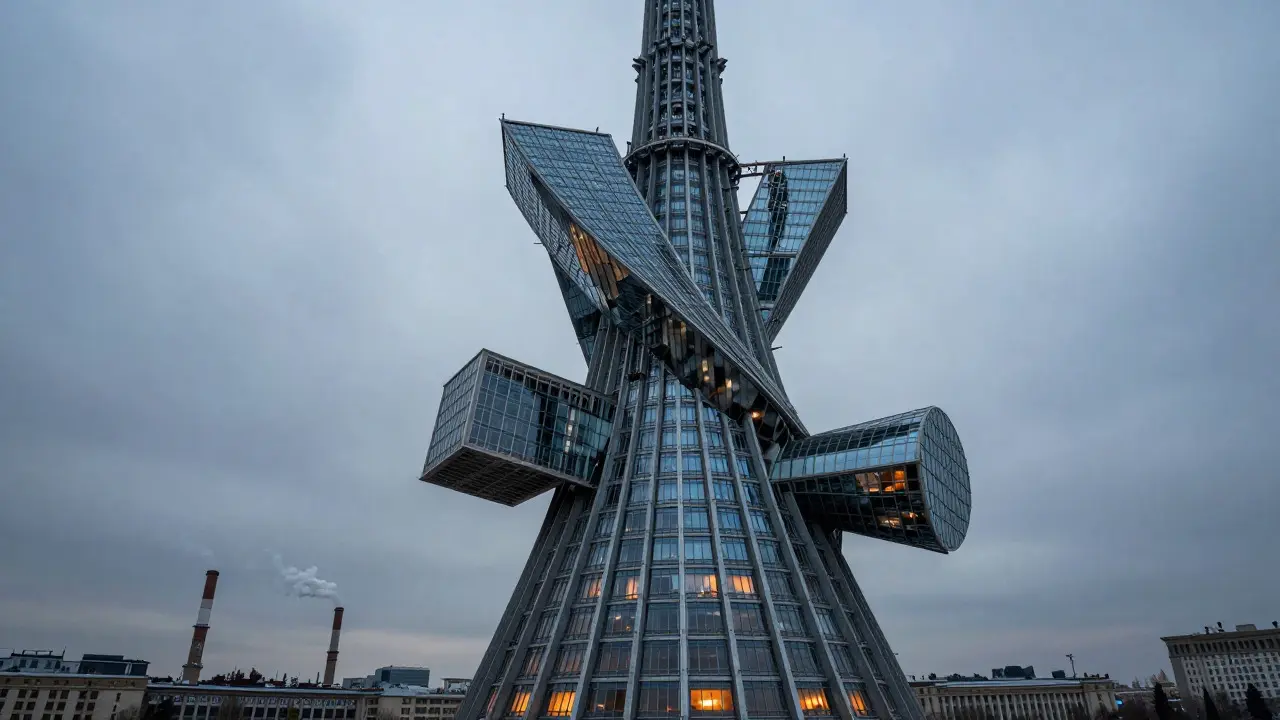
If there is one symbol that defines the ambition of Constructivist architecture, it is Tatlin's Tower (also known as the Monument to the Third International). Proposed in 1919, this structure was never built, yet it remains the most famous architectural model of the 20th century.
| Feature | Detail |
|---|---|
| Height | 400 meters (taller than the Eiffel Tower) |
| Structure | Steel frame with glass enclosures |
| Rotation Speed | Cubic volume: once per year; Pyramidal volume: once per month; Conical volume: once per day |
| Purpose | Housing for Comintern offices, broadcasting, and public announcements |
Why does this matter? Because Tatlin’s design introduced the idea of kinetic architecture. The building was meant to move. Different sections would rotate at different speeds, changing the building's silhouette and internal layout constantly. This challenged the static nature of traditional architecture. It suggested that a building could be alive, responsive, and dynamic. While engineering limitations prevented its construction, the concept influenced generations of futurist designs.
Materials as Truth: Steel, Glass, and Concrete
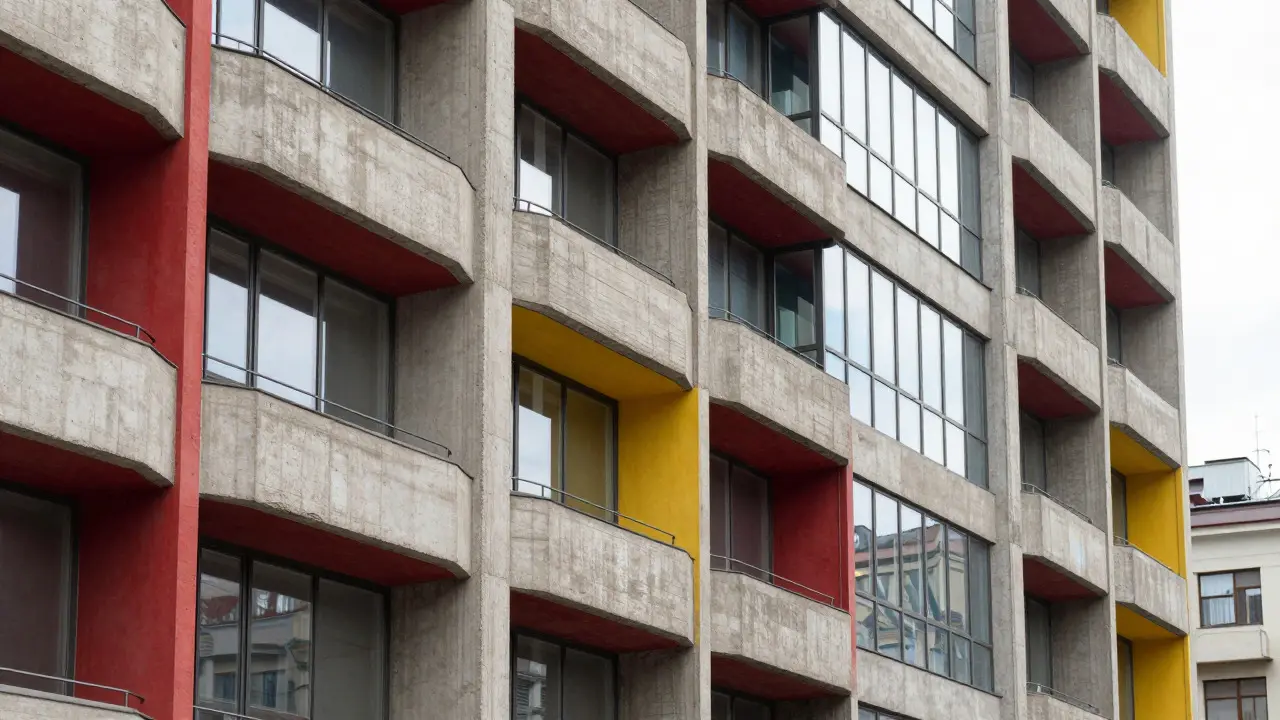
Constructivist architects refused to hide their materials. In classical architecture, stone might be carved to look like marble, or wood painted to resemble gold. Constructivists did the opposite. They exposed the skeleton of the building.
- Reinforced Concrete: Allowed for cantilevers and open floor plans. Architects could create floating balconies and asymmetrical forms that defied traditional load-bearing walls.
- Steel Frameworks: Provided tensile strength, enabling vast spans without interior columns. This created flexible, open spaces ideal for factories and communal housing.
- Glass Curtains: Used extensively to dissolve the boundary between inside and outside. Light was treated as a structural element, illuminating the interior and reflecting the industrial landscape.
This approach required a deep understanding of physics and engineering. Architects worked closely with engineers, blurring the lines between artist and technician. The result was buildings that looked like they were engineered first and decorated second-because they were.
Living Machines: The Narkomfin Building
While many grand visions remained models, some Constructivist projects were built and lived in. The most famous surviving example is the Narkomfin Building in Moscow, designed by Moisei Ginzburg and Ignaty Milinis in 1928.
The Narkomfin was not just an apartment block; it was a social experiment. It aimed to liberate women from domestic drudgery by providing communal facilities. Residents shared kitchens, laundries, libraries, and even a rooftop gymnasium. Private apartments were tiny, consisting mainly of a bedroom and a bathroom. The idea was that life happened in common spaces, fostering community interaction.
Architecturally, it featured a zigzagging corridor, colorful accents (red and yellow), and large windows that maximized light. Today, it stands as a UNESCO World Heritage site candidate, proving that radical social ideas can leave lasting physical marks. However, after Stalin came to power, such communal living fell out of favor, and many residents reverted to private cooking, undermining the original vision.
The Shift to Socialist Realism
By the mid-1930s, Constructivism was dead. Why? Because politics changed. Joseph Stalin favored a more monumental, classical style known as Socialist Realism. This style used neoclassical columns, domes, and statues to project stability and imperial power. Constructivism, with its abstract forms and internationalist ethos, was labeled "bourgeois formalism" and banned.
Many Constructivist architects were forced to adapt or disappeared from history. Some, like Ilya Golosov, managed to blend Constructivist techniques with more acceptable aesthetics. Others emigrated or switched to theater design. Despite this suppression, the seeds had been sown. The principles of functionalism, open plans, and honest materials traveled west, influencing the Bauhaus in Germany and the International Style in America.
Legacy in Modern Design
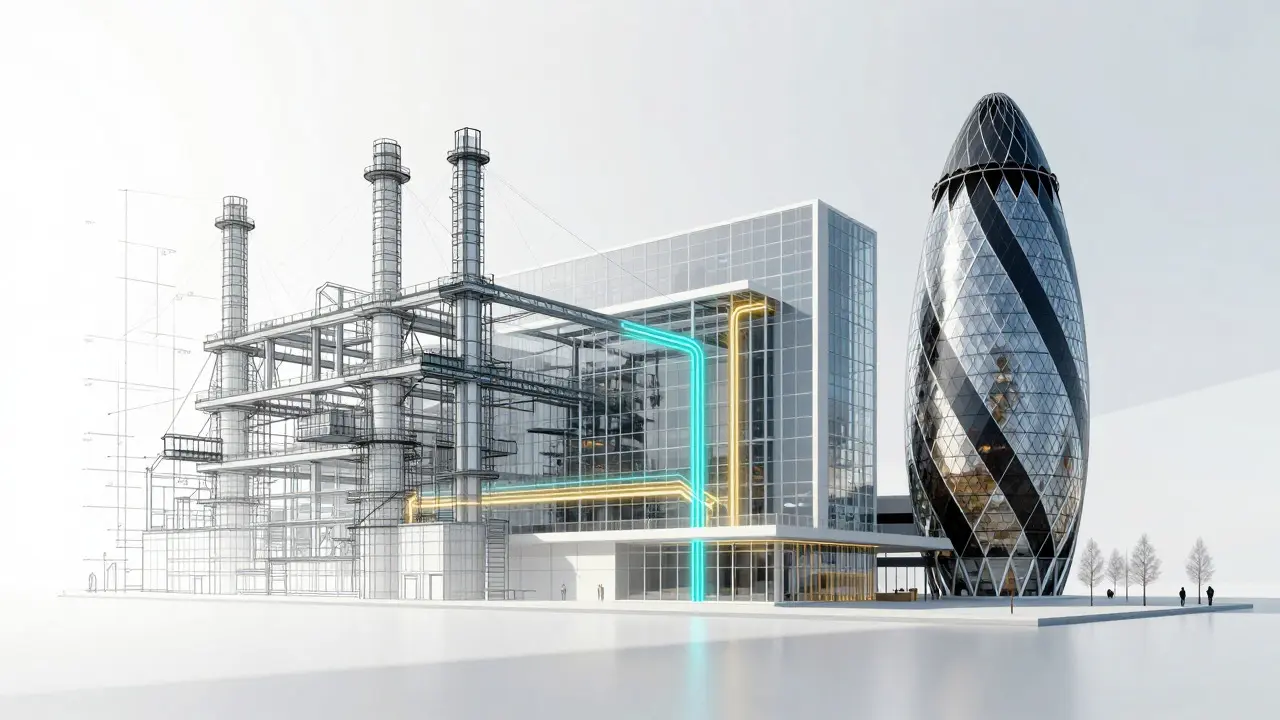
You don't have to look far to see Constructivism's DNA in today's world. Look at the high-tech skyscrapers of London or the transparent facades of contemporary museums. The emphasis on structural expression-where beams and cables are visible-is a direct descendant of Constructivist thought.
Consider the work of Norman Foster or Renzo Piano. Their buildings expose services and structure, much like Ginzburg did nearly a century ago. Even digital interfaces borrow from Constructivist graphic design: bold typography, geometric layouts, and a focus on clarity over decoration. The movement taught us that form follows function, but also that function can be beautiful.
Moreover, the current interest in sustainable architecture echoes Constructivist values. Using local materials, designing for efficiency, and creating communal spaces are all priorities now. Constructivism was ahead of its time in recognizing that architecture shapes society. As we face new challenges like climate change and urban density, revisiting these radical ideas offers valuable insights.
What is the main difference between Constructivism and Modernism?
While both movements emphasize function and reject ornamentation, Constructivism is specifically tied to Russian revolutionary politics and uses dynamic, often asymmetrical forms to express energy and movement. Modernism, particularly the International Style, tends toward static, rectilinear forms and universal solutions. Constructivism is more expressive and politically charged, whereas Modernism often seeks neutrality.
Are there any surviving Constructivist buildings I can visit?
Yes, several key examples survive in Moscow and St. Petersburg. The Narkomfin Building in Moscow is the most famous. Other notable sites include the Rusakov Textile Mill Workers' Club by Konstantin Melnikov and the Zuev Workers' Club in Saratov. Many require guided tours or special permission to access interiors.
Who were the key figures in Constructivist architecture?
Major figures include Vladimir Tatlin, Moisei Ginzburg, the Vesnin brothers (Viktor, Leonid, and Alexander), Konstantin Melnikov, and El Lissitzky. These individuals contributed through theory, design, and construction, shaping the movement's visual and ideological language.
Why did Constructivism disappear in the Soviet Union?
Stalin's rise to power brought a shift toward Socialist Realism, which favored traditional, monumental styles to convey state stability. Constructivism was criticized as too abstract and "Western," leading to its official ban in the 1930s. Architects who persisted faced professional marginalization.
How does Constructivism influence contemporary architecture?
Its influence is seen in High-Tech architecture, where structural elements are exposed, and in the use of industrial materials like steel and glass. The emphasis on functional zoning and communal spaces also resonates in modern urban planning and sustainable design practices.