The Timeless Tudor Architecture: A Classic Revived
 Dec, 29 2025
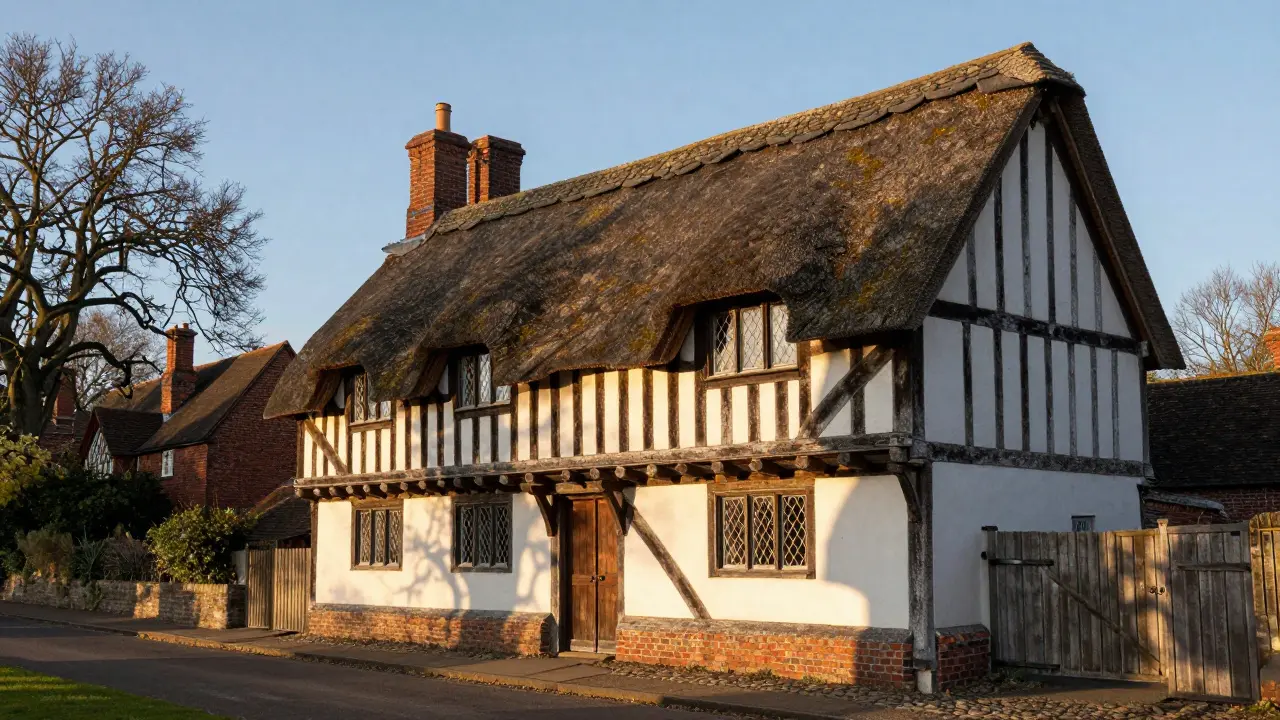
Walk through any old English village or a quiet American suburb with mature trees, and you might spot a house that looks like it stepped out of a Shakespeare play. Crooked beams, steep roofs, and white plaster walls with dark wood accents - these aren’t just decorative quirks. They’re the lasting fingerprints of Tudor architecture, a style that survived wars, revolutions, and modernist trends to come back stronger than ever.
What Makes Tudor Architecture Unique?
Tudor architecture isn’t just one thing. It’s a mix of medieval craftsmanship and early Renaissance ideas, born in England between 1485 and 1603 during the reign of the Tudor dynasty. The most obvious feature? Half-timbering. That’s when wooden frames form the structure of the house, and the gaps between them are filled with plaster or brick. The wood isn’t hidden - it’s celebrated. Dark, stained beams crisscross the walls like a lattice, creating bold, geometric patterns that catch the light in unexpected ways.
These homes aren’t symmetrical. They don’t follow strict rules. Gables jut out at odd angles, chimneys rise in clusters, and windows are small, often grouped together in diamond-shaped panes made of hand-blown glass. The roofs are steep - sometimes over 45 degrees - to shed rain and snow efficiently. And because brick was expensive back then, many homes used timber for the frame and wattle-and-daub (a mix of woven sticks and mud) for the walls. Over time, the plaster turned white, and the wood darkened, giving Tudor homes their signature contrast.
Inside, the layout was practical. Large fireplaces dominated the main hall, where families gathered. Ceilings were low by today’s standards, not because people were shorter, but because heat rose and keeping it trapped was essential in cold winters. Floors were often made of packed earth or stone, later replaced with wide-plank oak. Many homes had overhanging upper floors - called jettying - which maximized space on narrow lots and protected the lower walls from rain.
Why Did Tudor Architecture Disappear - and Then Come Back?
By the late 1600s, the style faded. The Great Fire of London in 1666 destroyed thousands of timber-framed buildings. New building codes demanded brick and stone to prevent fires. The Enlightenment brought a taste for order, symmetry, and classical lines - think Palladian villas and Georgian townhouses. Tudor homes looked old-fashioned, even primitive, to 18th-century tastes.
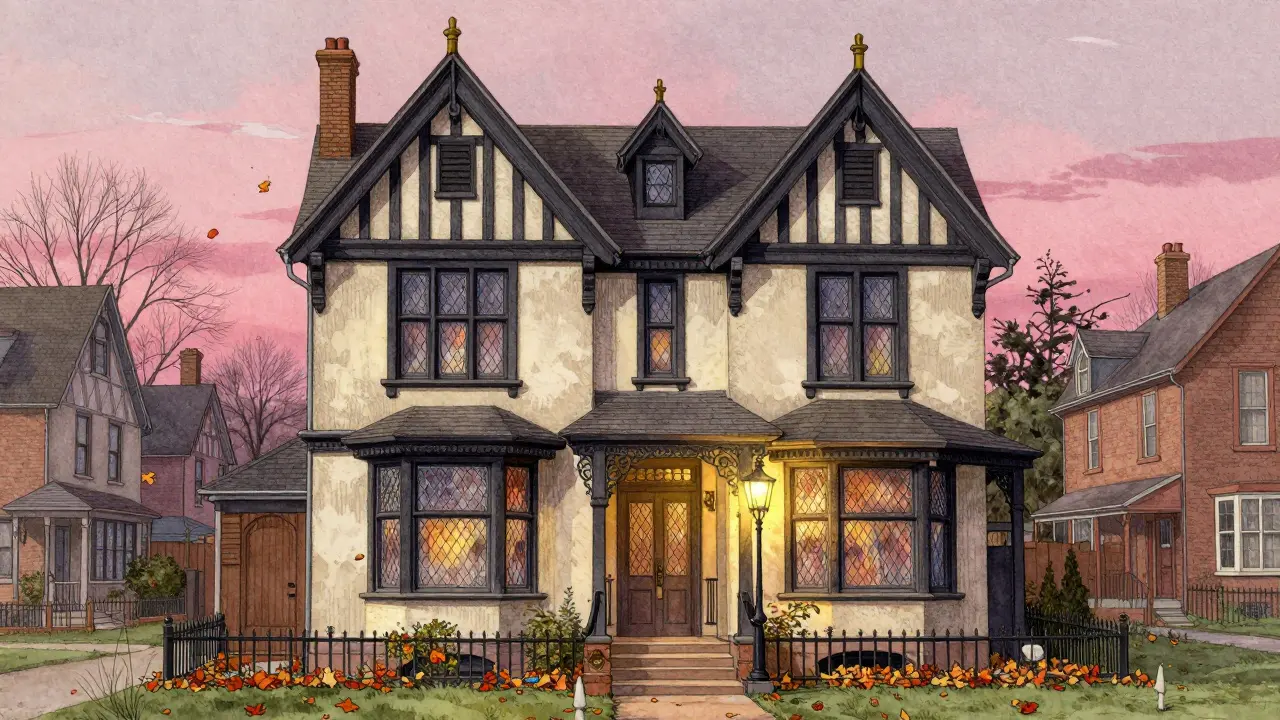
But in the 1800s, something changed. The Romantic movement revived interest in the medieval past. Writers like Walter Scott painted Tudor England as a land of chivalry and charm. Architects began copying old designs, not as replicas, but as nostalgic interpretations. The Victorian era saw a surge in “Tudor Revival” homes, especially among the wealthy. By the early 1900s, American suburbs began adopting the style. Developers realized it had instant curb appeal - it looked historic, solid, and cozy.
Today, Tudor Revival isn’t just a throwback. It’s a living style. New homes built in the 2020s still use half-timbering, steep gables, and leaded windows. But they’re smarter. Modern insulation hides behind plaster. Energy-efficient windows mimic the old diamond panes. Foundations are concrete, not stone. The charm is preserved, but the comfort isn’t sacrificed.
Where You’ll Find Tudor Architecture Today
In England, the original Tudor homes still stand - but they’re rare. Places like Stratford-upon-Avon, Lavenham, and York have clusters of well-preserved examples. The Merchant’s House in Lavenham, built around 1525, still has its original timber frame and carved details. In the U.S., the style exploded between 1910 and 1940. Neighborhoods in Cleveland, Chicago, and Los Angeles are full of Tudor Revival houses. The Biltmore Estate in Asheville, North Carolina, isn’t a home - it’s a castle, but it uses Tudor elements like arched doorways and ornamental chimneys.
Even today, developers use Tudor details to sell homes. A 2023 survey by the National Association of Home Builders found that 18% of new custom homes in the Midwest and Northeast included Tudor-inspired features, even if they weren’t full revivals. Buyers don’t just want a house - they want a story. And Tudor architecture delivers that in spades.
The Practical Appeal of Tudor Design
Why do people keep choosing this style? It’s not just nostalgia. Tudor homes have real advantages. The steep roof sheds snow and rain easily, reducing leaks. The thick walls - often 18 inches or more - provide natural insulation. The small windows reduce heat loss, and the overhanging eaves protect the walls from weathering.
Modern builders adapt these traits for efficiency. A 2022 study by the University of Sheffield analyzed 47 restored Tudor homes and found that those with updated insulation and double-glazed windows cut heating costs by 32% compared to pre-renovation levels. That’s not bad for a style from the 1500s.
And then there’s the curb appeal. A 2024 Zillow analysis showed that homes with Tudor-style exteriors sold 12% faster than comparable homes in other styles in the same neighborhoods. Buyers see them as timeless, not trendy. They don’t go out of fashion because they never really followed fashion in the first place.
What to Watch Out For in Tudor Homes
Not all Tudor-style homes are created equal. Original ones from the 1500s need serious upkeep. Timber frames can rot if moisture gets trapped. Plaster can crack. Lead paint and asbestos are common in homes built before 1970. Renovating one requires specialists - not just any contractor can handle it.
Even modern Tudor Revival homes can have problems. Some builders use fake timber - thin wood strips glued onto the wall to look like half-timbering. They’re cheaper but don’t last. Real timber frames are structural; fake ones are just decoration. Look for the beams: if they’re the same width all the way through, they’re likely fake. Real beams taper slightly at the ends, following traditional carpentry.
Windows are another red flag. Original Tudor windows had tiny panes held together by lead cames. Modern replacements use single-pane glass with simulated muntins - plastic strips that look like divided lights. They’re cheaper, but they don’t insulate well. Ask if the windows are double-glazed with low-E coating. If not, you’re paying for looks, not efficiency.
How to Spot a Real Tudor Home
If you’re looking at a home and wondering if it’s authentic, here’s what to check:
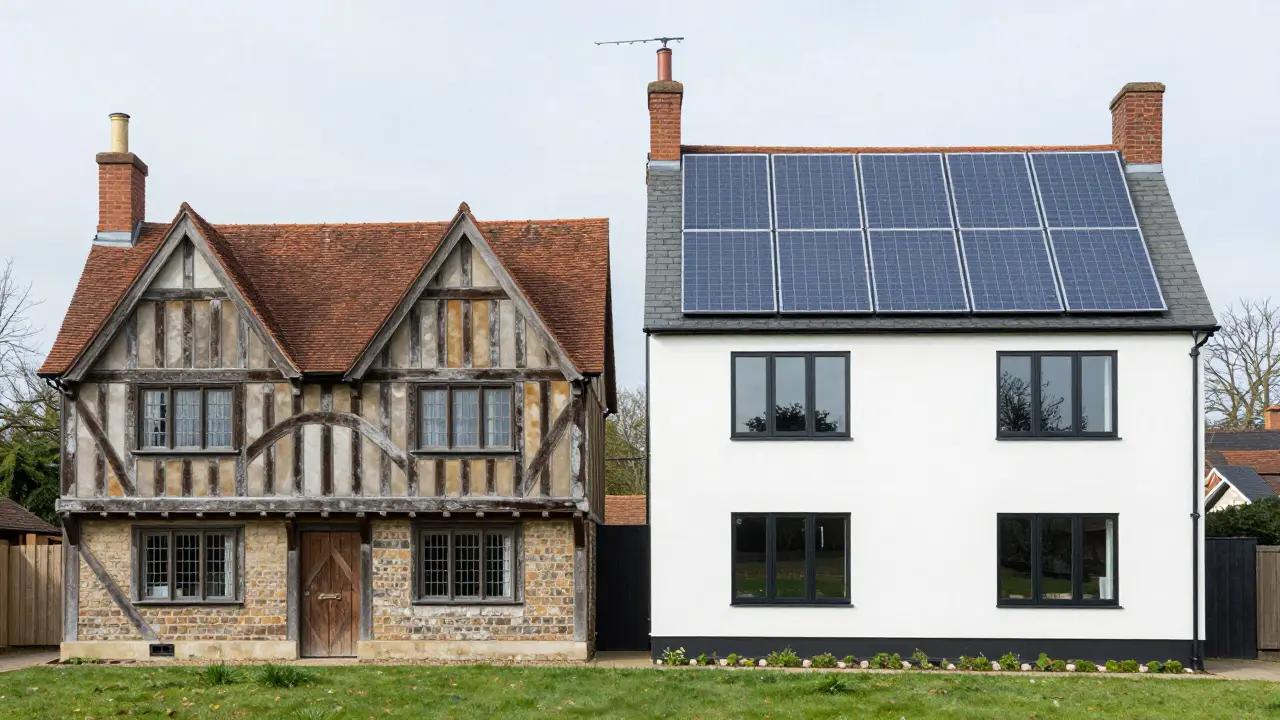
- Timber frame: Real beams are thick, uneven, and hand-hewn. They show tool marks and knots. Fake ones are smooth, uniform, and often painted black.
- Roof: Original Tudor roofs used clay tiles or thatch. Modern ones use asphalt shingles shaped to look like tiles.
- Chimneys: Tudor chimneys are tall, clustered, and often made of brick with decorative caps. If there’s only one chimney, it’s likely not original.
- Windows: Look for diamond-shaped panes with lead lines. If the glass is clear and uniform, it’s modern.
- Layout: Original homes had a central hall with rooms branching off. Modern versions often have open floor plans.
If the house has a basement, it’s probably not Tudor. Most original homes had no basement - they sat directly on stone or earth foundations.
Why Tudor Architecture Still Matters
Tudor architecture isn’t just about looking old. It’s about building with intention. Every beam had a purpose. Every window was placed for light, not just aesthetics. The style didn’t follow trends - it followed function. And that’s why it’s still relevant.
In a world of glass towers and minimalist boxes, Tudor homes remind us that buildings can be warm, human-scaled, and full of character. They don’t scream for attention. They whisper. And in a noisy world, that’s powerful.
Today’s architects are learning from Tudor design again - not to copy it, but to borrow its wisdom. Thick walls. Natural materials. Passive heating. Local craftsmanship. These aren’t复古 trends. They’re timeless principles.
Are Tudor homes expensive to maintain?
Yes, original Tudor homes can be costly to maintain due to aging timber frames, crumbling plaster, and outdated systems. Restoring real half-timbering requires specialized carpenters and can cost $50,000 or more for a small home. Modern Tudor Revival homes are cheaper to upkeep because they use modern materials like pressure-treated wood and synthetic plaster, but they still need regular inspections for moisture damage.
Can you modernize a Tudor home without losing its character?
Absolutely. Many owners add open-plan kitchens, central HVAC, and smart home systems while keeping the exterior intact. The key is preserving the roofline, window shapes, and timber detailing. Inside, you can remove non-load-bearing walls and install energy-efficient windows that mimic the original diamond panes. The goal isn’t to make it look new - it’s to make it live better.
Is Tudor architecture only found in England and the U.S.?
No. Tudor Revival homes appear across Canada, Australia, and parts of Europe, especially in areas settled by British colonists. In Germany and the Netherlands, similar half-timbered houses called Fachwerk buildings existed long before Tudor style, and many were restored or copied during the 19th-century revival. But the English Tudor version - with its ornate chimneys and jettying - is the most widely recognized.
Do Tudor homes have any environmental benefits?
Yes. Their thick walls and small windows reduce heat loss. Original materials like oak, lime plaster, and clay tiles are natural and biodegradable. Modern retrofits with insulation and efficient windows make them even greener. A 2023 study in the Journal of Architectural Conservation found that restored Tudor homes had a 40% lower carbon footprint over 50 years compared to new builds using concrete and steel.
Why do real estate agents love Tudor homes?
Because they sell faster and often at a premium. Buyers associate Tudor homes with quality, history, and charm. In neighborhoods with similar homes, Tudor properties typically command 8-15% higher prices than modern-style homes. They also attract fewer price negotiations because buyers see them as unique, not interchangeable.