The Signature Features of Gothic Revival Architecture
 Mar, 21 2026
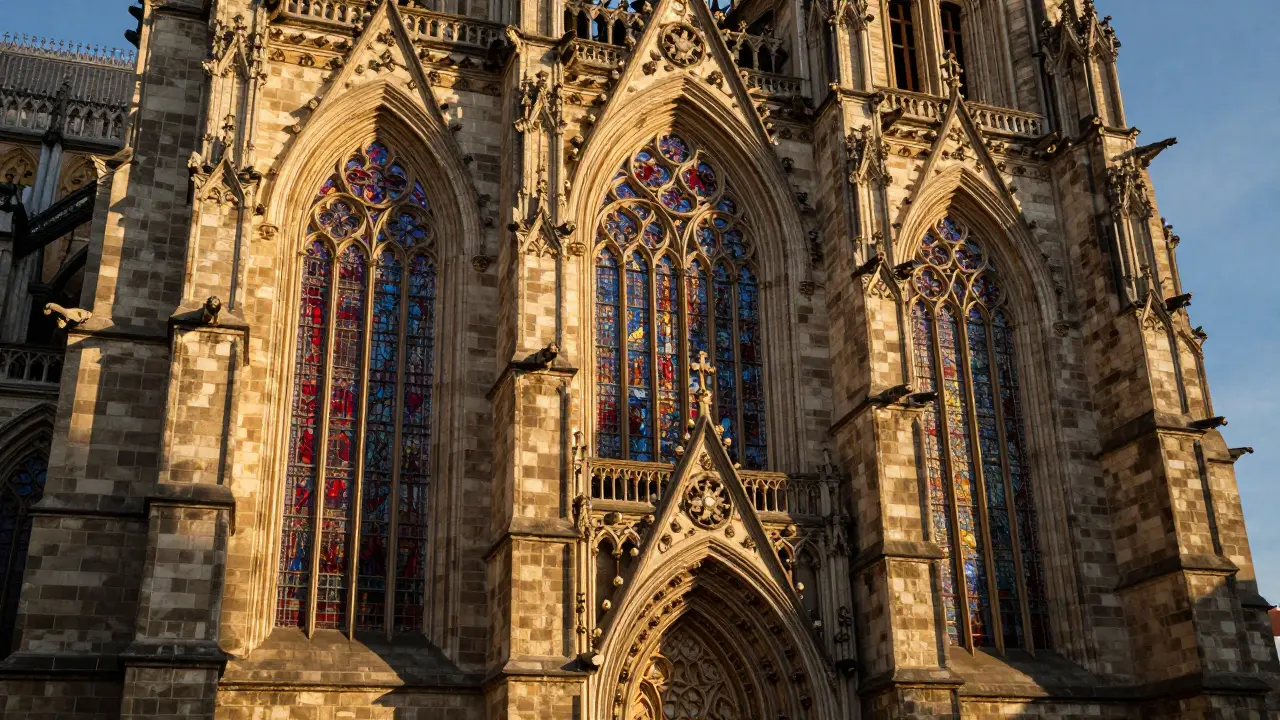
When you walk past a church with tall, narrow windows, stone carvings of gargoyles, and a spire that seems to pierce the sky, you’re looking at Gothic Revival architecture. It’s not ancient-it’s a 19th-century comeback. But it doesn’t feel like a revival. It feels like magic. This style didn’t just copy medieval buildings. It reimagined them with new materials, new purposes, and a deep hunger for drama. And its signature features? They’re not just decorative. They’re engineering feats wrapped in symbolism.
Pointed Arches: More Than Just a Shape
The pointed arch is the first thing you notice. Unlike the rounded arches of Romanesque buildings, Gothic Revival uses arches that come to a sharp point. This isn’t just aesthetics. Pointed arches redirect weight more efficiently downward, letting builders make taller walls and thinner supports. That’s why Gothic Revival churches feel so airy inside, even with thick stone walls. You’ll see them over doors, windows, and even in decorative arcades. They’re everywhere. And they’re not just functional-they’re intentional. The upward pull of the arch was meant to lift your eyes toward heaven.
Flying Buttresses: The Hidden Skeleton
Look at the outside of a Gothic Revival building and you’ll see stone arms reaching out from the walls like giant fingers. These are flying buttresses. They look like they belong in a fantasy movie, but they’re pure engineering. In medieval times, they were built to counteract the outward push from high vaulted ceilings. In the 1800s, architects revived them not because they had to, but because they were iconic. Modern materials like iron and steel could’ve handled the load, but they kept the buttresses anyway. Why? Because they told a story. They made the building look like it was straining upward, alive with tension. You’ll find them on cathedrals, universities, and even city halls built in this style.
Stained Glass Windows: Light as a Message
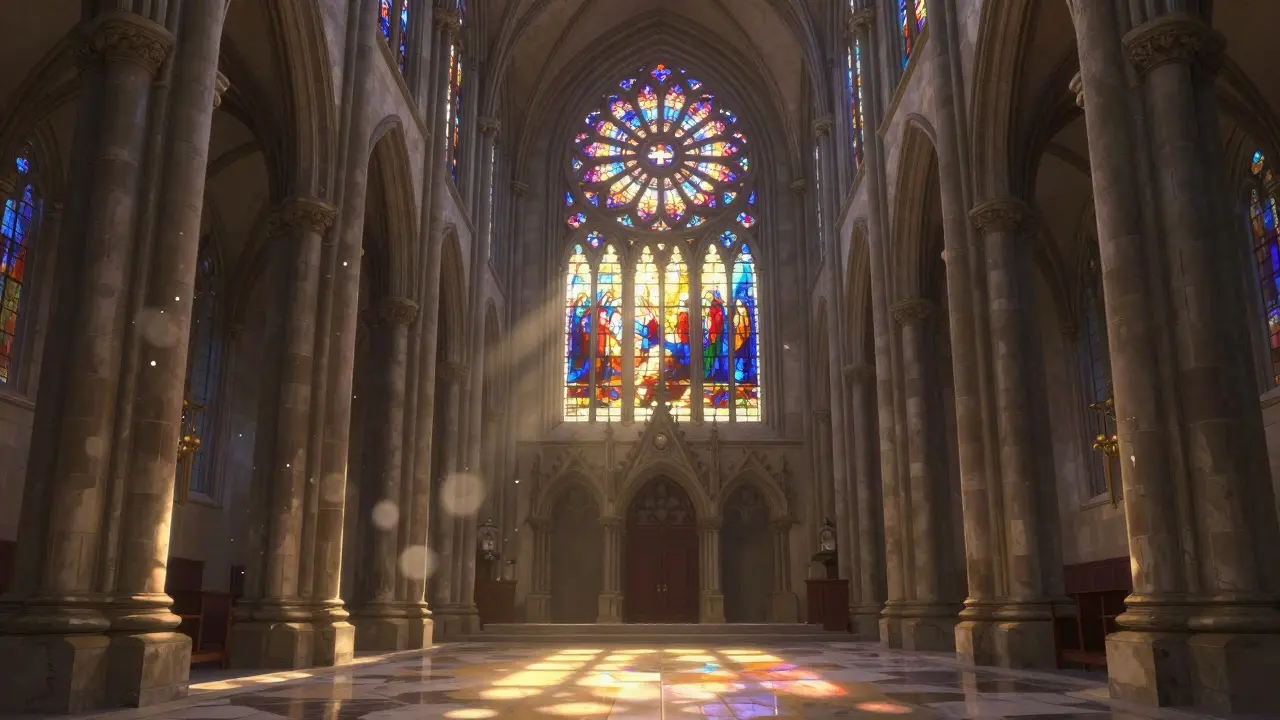
Imagine sunlight pouring through deep red, blue, and gold glass, painting the floor in shifting patterns. That’s the power of stained glass in Gothic Revival architecture. These windows weren’t just pretty. They were Bibles for the illiterate. Scenes from the Bible, saints, angels-every pane told a story. The technique was revived with new chemistry: cobalt for blue, copper for red, gold for amber. Some windows in Gothic Revival churches are over 50 feet tall. The most famous example? The Great Rose Window at the Cathedral of Saint John the Divine in New York. It took 20 years to complete. And yes, it still glows.
Spires and Towers: Reaching for the Divine
Every Gothic Revival building has at least one spire. Some have dozens. These aren’t just tall towers-they’re vertical statements. In the 19th century, cities competed to build the tallest spires. The spire of the Washington National Cathedral in D.C. rises 301 feet. The spire of the Church of Our Lady of the Assumption in Montreal hits 270 feet. Why so tall? Because height meant closeness to God. But there was also a cultural shift. Industrialization made people long for something timeless. A spire wasn’t just a building feature-it was a protest against the rising smokestacks. It said: here is something that doesn’t bend to machines.
Ornate Carving and Gargoyles: Stone That Speaks
Walk under the eaves of a Gothic Revival building and you’ll see faces. Some are serene. Others are twisted, snarling, half-beast. These aren’t random decorations. They’re gargoyles and grotesques. Gargoyles actually function as water spouts, directing rain away from the walls. Grotesques? Pure ornament. Both were common in medieval cathedrals and brought back with full force in the 1800s. Carvers went wild: dragons, angels, monks, demons, even local politicians carved as devils. The University of Toronto’s Hart House has over 200 carved figures. Each one has a name. Each one has a story. They’re not scary for the sake of it. They’re reminders that the sacred and the strange live side by side.
Vertical Emphasis and Asymmetry
Unlike the balanced, symmetrical buildings of the Renaissance, Gothic Revival embraces asymmetry. Towers rise unevenly. Windows cluster in odd groups. The whole structure feels like it’s growing, not built. This wasn’t a mistake. It was a philosophy. Gothic Revival architects wanted to mimic the organic, evolving nature of medieval cathedrals-structures that took centuries to finish. The result? Buildings that feel alive. The Library of Congress in Washington, D.C., has a tower that leans slightly to one side. It wasn’t built that way on purpose. But it fits. It looks like it was always meant to tilt.
Use of Modern Materials with Medieval Forms
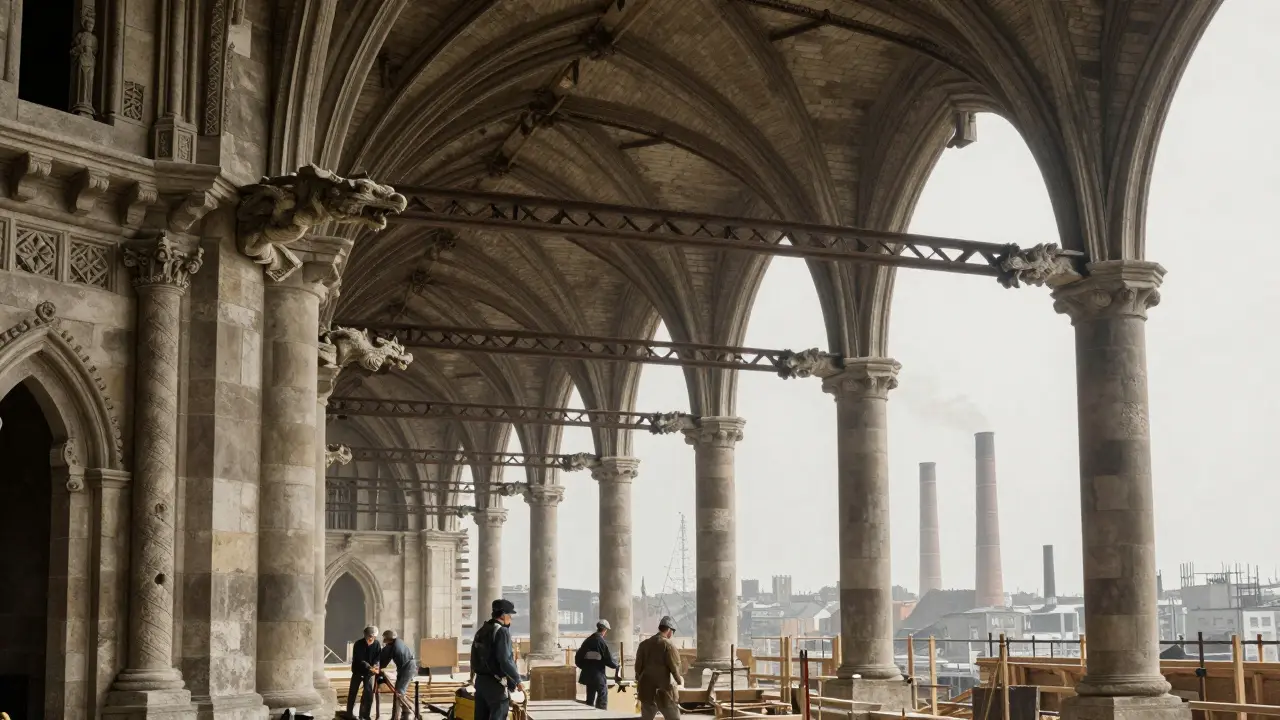
This is the trickiest part. Gothic Revival didn’t just use stone. It mixed stone with cast iron, steel, and even early concrete. The Eiffel Tower? Not Gothic. But the interior of the Sainte-Chapelle in Paris? Replicated in steel and glass in the 1870s. The same goes for train stations and government buildings. The Pennsylvania Railroad Station in Philadelphia (built 1881) used iron trusses to support soaring vaults. It looked medieval, but it was built with the tools of the Industrial Revolution. That’s the genius of the style. It didn’t reject progress. It dressed it in ancient robes.
Why It Still Matters Today
You’ll find Gothic Revival in places you wouldn’t expect. College campuses. City halls. Even libraries. Why? Because it wasn’t just about religion. It was about identity. In the 1800s, nations were forming. Countries like Britain and the U.S. wanted to connect to a noble past. Gothic Revival gave them a visual language of permanence, craftsmanship, and moral purpose. It said: we are not just modern. We are rooted.
Today, you’ll see it in restored churches, university chapels, and even some modern churches that still use pointed arches and stained glass. It’s not a relic. It’s a template. The way light moves through a Gothic window. The way stone seems to float on air. The way a spire cuts through a skyline. That’s not just architecture. It’s emotion made visible.
What’s the difference between Gothic and Gothic Revival architecture?
Gothic architecture refers to the original style built between the 12th and 16th centuries in Europe-think Notre-Dame in Paris or Salisbury Cathedral. Gothic Revival is the 19th-century movement that copied and adapted those forms using modern materials and techniques. It wasn’t about rebuilding old churches. It was about using the past to express new ideas-like nationalism, spirituality, and industrial pride.
Is Gothic Revival architecture only used in churches?
No. While it started with religious buildings, by the mid-1800s, it became popular for universities, courthouses, libraries, and even homes. The University of Chicago, the British Houses of Parliament, and the New York Public Library all feature strong Gothic Revival elements. Even some 19th-century mansions in Boston and Philadelphia used pointed windows and ornate stonework to signal wealth and cultural taste.
Why did Gothic Revival become popular in the 19th century?
It was a reaction to industrialization. As cities grew crowded and factories replaced craftsmanship, people longed for beauty, tradition, and spiritual depth. Writers like John Ruskin and architects like Augustus Pugin argued that medieval design reflected moral integrity. Gothic Revival became a way to reclaim dignity in design. It wasn’t nostalgia-it was a protest.
Can you still see Gothic Revival buildings today?
Absolutely. Many are still in active use. The Cathedral of Saint John the Divine in New York, the University of Notre Dame’s Main Building, and the Palace of Westminster in London are all prime examples. Even smaller towns have Gothic Revival courthouses or churches. They’re not just preserved-they’re lived in, worshipped in, and studied in. Their stonework still holds up. Their stained glass still glows. They’re not museum pieces. They’re living architecture.
What’s the most iconic Gothic Revival building in the U.S.?
The Washington National Cathedral in Washington, D.C., is widely considered the most iconic. It took 83 years to build, from 1907 to 1990. It has 112 stained glass windows, 108 gargoyles, and a central spire that rises 301 feet. It’s also the only cathedral in the U.S. built in the Gothic Revival style with full medieval fidelity-and it’s still actively used for national events.