The Renaissance: A Period of Extraordinary Achievements in Art, Science, and Thought
 Mar, 7 2026
The Renaissance wasn’t just a time when people painted better portraits or built prettier buildings. It was the moment Europe stopped looking backward and started asking bold new questions - about the human body, the stars, the nature of power, and what it meant to be alive. Between the 14th and 17th centuries, a quiet revolution unfolded across Italy and then spread through Europe, fueled by rediscovered texts, bold experimentation, and a fierce belief in human potential.
What Made the Renaissance Different?
Before the Renaissance, much of European thought was shaped by religious dogma and medieval traditions. Knowledge was often passed down through church-approved sources. But then, something shifted. Scholars started digging up ancient Greek and Roman manuscripts - texts on philosophy, medicine, astronomy, and rhetoric - that had been lost or ignored for centuries. These weren’t just old books. They were blueprints for a new way of thinking.
The word humanism became the heartbeat of this movement. Humanists didn’t reject religion. Instead, they focused on human experience - reason, emotion, creativity, and individual dignity. They believed people could shape their own lives, not just accept their place in a rigid social order. This idea didn’t stay in libraries. It spilled into art, politics, and daily life.
Art That Changed the World
Look at a painting from before the Renaissance - flat figures, stiff poses, little depth. Now look at Leonardo da Vinci’s Virgin of the Rocks or Michelangelo’s David. The difference is staggering. Artists began studying anatomy, light, and perspective. They didn’t just copy what they saw; they understood how the human body moved, how shadows fell, how space worked in three dimensions.
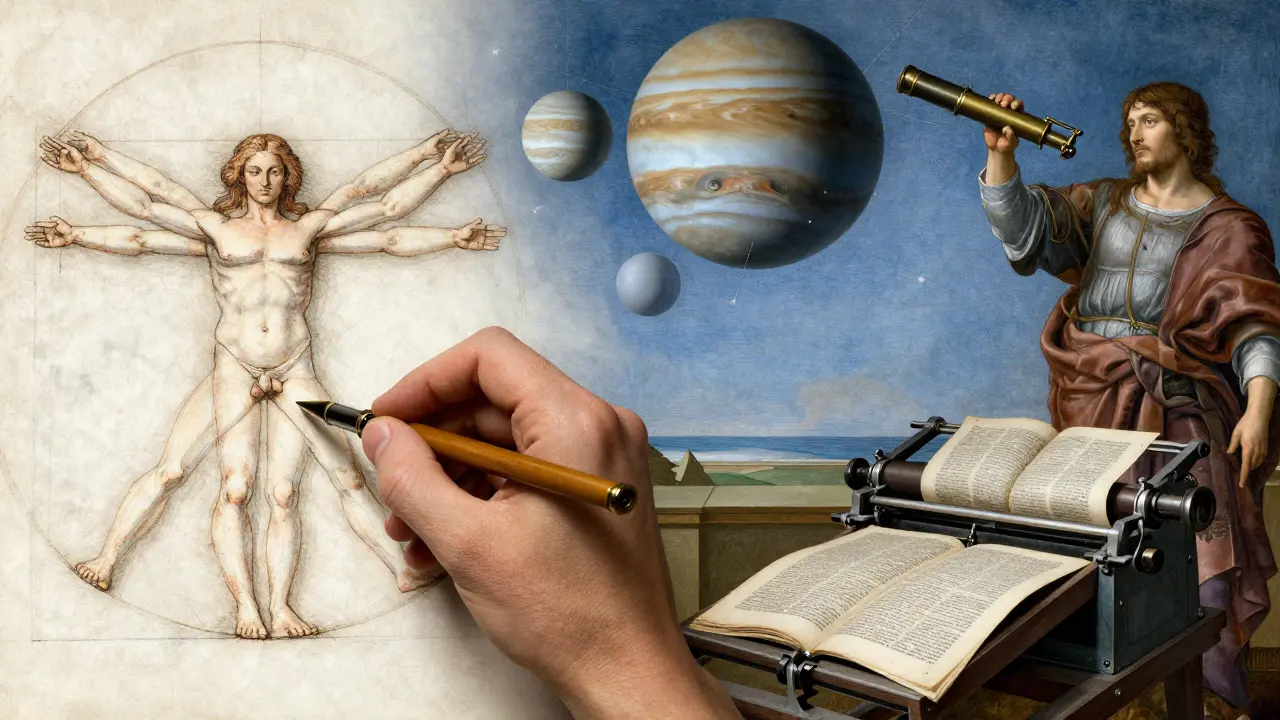
Leonardo didn’t just paint. He dissected corpses to map muscles and tendons. He sketched flying machines and hydraulic pumps while working on the Mona Lisa’s smile. Michelangelo carved marble like it was clay, revealing forms trapped inside the stone. Raphael, with his calm, balanced compositions, made harmony itself a visual language.
These weren’t just artists. They were scientists, engineers, and philosophers in paint and marble. Their work didn’t hang in churches to scare or comfort. It celebrated human beauty, intellect, and curiosity.
Science That Broke the Rules
The Renaissance didn’t stop at art. It tore open the doors of science. For centuries, people accepted Aristotle’s ideas about the universe - like the belief that Earth was the center of everything. But in 1543, Nicolaus Copernicus published On the Revolutions of the Heavenly Spheres. He didn’t just suggest Earth moved around the Sun - he proved it mathematically. It was a shock. A heresy to some. A breakthrough to others.
Galileo Galilei took it further. He built a telescope, pointed it at the stars, and saw moons orbiting Jupiter. That meant not everything revolved around Earth. The Church didn’t like it. He was silenced. But the idea stuck. The universe wasn’t a divine clockwork with Earth at its center. It was vast, mysterious, and governed by laws we could discover.
And then there was Andreas Vesalius. He didn’t just read ancient medical texts. He cut open dead bodies - real ones - and drew what he found. His book De humani corporis fabrica corrected over a thousand errors in Galen’s 1,300-year-old anatomy guide. For the first time, medicine was based on observation, not tradition.
Architecture That Reimagined Space
While artists and scientists were changing how we saw the world, architects were changing how we moved through it. Gothic cathedrals had soared toward heaven with pointed arches and stained glass. Renaissance builders turned to symmetry, proportion, and geometry - inspired by Roman temples and Greek columns.
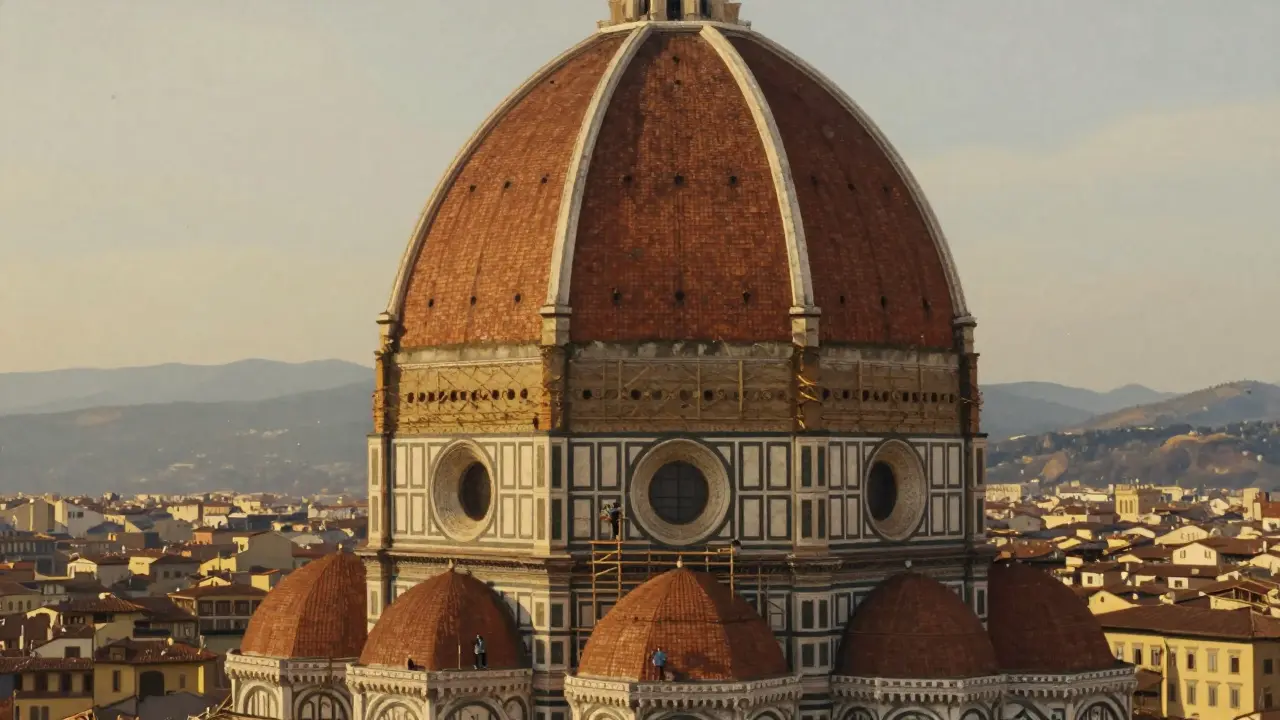
Filippo Brunelleschi designed the dome of Florence’s cathedral - a feat no one thought possible. He didn’t use wooden centering frames like before. He invented a herringbone brick pattern that let the dome support itself as it rose. It still stands today, 45 meters wide and 114 meters high. It didn’t just hold up a building. It held up a new idea: that humans could solve impossible problems.
Andrea Palladio took those principles and turned them into a language. His villas in northern Italy used balanced facades, domes, and porticos. His designs became so influential that they shaped buildings from London to Washington, D.C. The U.S. Capitol? Its dome owes a debt to Palladio.
The Ripple Effect: Beyond Italy
The Renaissance didn’t stay in Florence or Rome. It traveled. Through trade, war, and printing presses - yes, the printing press, invented by Gutenberg around 1440 - ideas spread faster than ever before. Books that once cost a fortune could now be bought for a few coins. Literacy rose. Debate grew. People began to think for themselves.
In England, Thomas More wrote Utopia, imagining a society based on reason, not inherited power. In the Netherlands, Erasmus criticized corruption in the Church and called for a return to original Christian texts. In Spain, painters like El Greco fused Italian techniques with spiritual intensity. Even in distant courts, rulers hired Italian artists and architects to show off their power - and their openness to new ideas.
The Renaissance wasn’t a single event. It was a chain reaction. One breakthrough led to another. A new way of seeing led to new ways of building, writing, governing, and questioning.
Why It Still Matters Today
We live in a world shaped by Renaissance thinking. The idea that knowledge comes from observation, not authority? That’s the foundation of modern science. The belief that art should reflect real human emotion? That’s why we still connect with Picasso, Van Gogh, and even Netflix dramas. The push for individual rights, education, and critical thinking? Those roots stretch back to humanist classrooms in 15th-century Florence.
When you look up at a building with clean lines and perfect proportions, you’re seeing the Renaissance. When you read a news article that asks you to think, not just believe, you’re reading in the spirit of Erasmus. When you study biology and trace how blood flows through the heart - not because Aristotle said so, but because Vesalius measured it - you’re continuing the Renaissance legacy.
This wasn’t just a golden age of art. It was the moment humanity decided to stop waiting for divine answers and start asking its own questions. And that’s the real achievement.
What were the main causes of the Renaissance?
The Renaissance didn’t happen overnight. It was sparked by several key factors: the rediscovery of ancient Greek and Roman texts after the fall of Constantinople in 1453, the rise of wealthy merchant families like the Medici who funded artists and scholars, the invention of the printing press that spread ideas quickly, and the growth of cities where trade and learning could flourish. Political stability in places like Florence and Venice also allowed culture to thrive.
Did the Renaissance only happen in Italy?
No. While Italy - especially Florence, Rome, and Venice - was the birthplace, the Renaissance spread across Europe. In northern Europe, artists like Albrecht Dürer in Germany and Jan van Eyck in Flanders developed their own styles. England saw the rise of writers like Shakespeare and thinkers like Thomas More. France and Spain adopted Italian styles in art and architecture. Each region added its own flavor, but the core ideas - humanism, observation, and innovation - remained the same.
How did the printing press change the Renaissance?
Before the printing press, books were copied by hand - slow, expensive, and rare. After Gutenberg’s invention around 1440, books could be printed in hundreds or thousands. Suddenly, a scholar in Paris could read the same text as one in Venice. Ideas spread faster than ever. Religious debates, scientific discoveries, and philosophical works reached ordinary people. Literacy rates rose. The printing press turned the Renaissance from an elite movement into a public revolution.
Was the Renaissance a peaceful time?
Not at all. While art and science flourished, Europe was still deeply divided. Wars between city-states, religious conflicts, and political intrigue were common. The Medici family ruled Florence through both wealth and manipulation. The Church fought to maintain control over ideas. Many thinkers, like Galileo and Giordano Bruno, faced persecution. The Renaissance wasn’t a utopia - it was a tense, messy, brilliant struggle between old rules and new possibilities.
How did Renaissance ideas influence modern education?
The Renaissance created the modern idea of a well-rounded education - the liberal arts. Instead of focusing only on theology or trade, students studied grammar, rhetoric, history, poetry, and moral philosophy. This became the foundation of universities across Europe and later in America. Today’s emphasis on critical thinking, debate, and studying the classics in schools and colleges comes directly from Renaissance humanists who believed education should shape not just skills, but character.