The American Craftsman: How Art, Functionality, and History Shape This Enduring Home Style
 Dec, 4 2025
Craftsman Home Authenticity Checker
Check Your Home's Authenticity
Based on the article's criteria, answer these 5 questions to determine if a home has authentic Craftsman features.
Craftsman Authenticity Results
Why this matters
Authentic Craftsman homes feature craftsmanship that has lasted over 100 years. The differences in materials and construction make them uniquely durable and valuable.
When you think of a cozy, sturdy home with wide porches, exposed beams, and hand-built woodwork, you’re picturing the American Craftsman. This style didn’t just appear out of nowhere-it was born from a rebellion. In the early 1900s, people were tired of overly ornate Victorian homes that looked more like stage sets than places to live. They wanted something real. Something made by hand. Something that felt like home.
Where the American Craftsman Came From
The American Craftsman style didn’t invent itself. It grew from the Arts and Crafts movement, which started in England in the 1860s as a reaction to industrialization. Designers like William Morris believed machines were destroying the soul of craftsmanship. They pushed for handmade goods, natural materials, and honest construction. This idea crossed the Atlantic and landed in the U.S. with architects like Gustav Stickley, who published The Craftsman magazine starting in 1901. His magazine wasn’t just about style-it was a manifesto. He showed readers how to build their own homes, design furniture, and live simply.
By 1910, Craftsman homes were everywhere-from the suburbs of Chicago to the hills of California. They weren’t just for the rich. Stickley designed affordable plans that middle-class families could build themselves. That’s why you’ll still see them today in small towns and cities across the country. They’re not relics. They’re survivors.
What Makes a House a Craftsman?
Not every house with a porch is a Craftsman. The real ones have specific traits that set them apart. Look for these five features:
- Low-pitched gable roofs with wide, overhanging eaves. The roof isn’t just for show-it protects the walls and creates deep shade.
- Exposed rafters and decorative knee braces. These aren’t hidden behind drywall. They’re left visible, like the skeleton of the house.
- Handcrafted woodwork. Doors, trim, built-in cabinets, and stair railings are all made from solid wood, often oak or cherry. You can see the grain. You can feel the texture.
- Front porches supported by thick square or tapered columns. These aren’t flimsy posts. They’re often made of stone or wood, sometimes with brick or stone piers at the base.
- Double-hung windows with divided panes, usually arranged in a 2-over-1 or 4-over-1 pattern. Many have stained glass accents near the top.
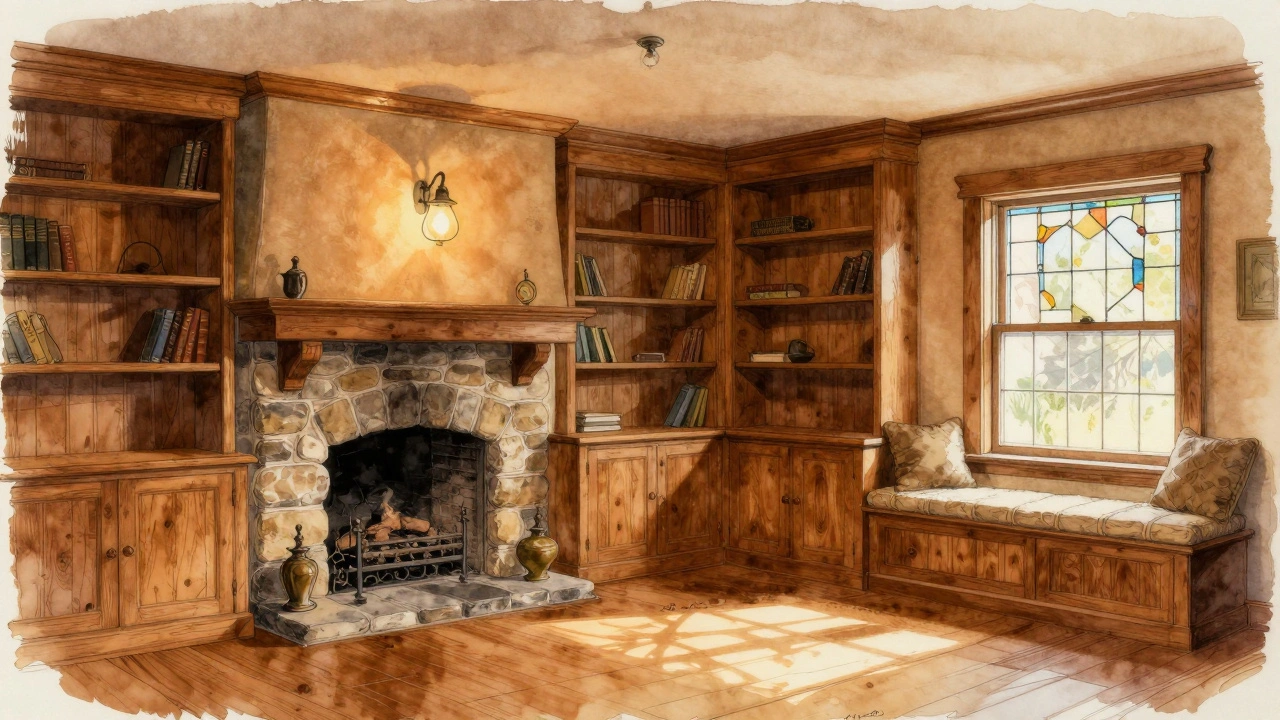
Inside, you’ll find built-in bookshelves, window seats, and fireplace surrounds that match the woodwork. The rooms aren’t huge, but they feel warm because everything is connected-no wasted space, no fake details. Even the light fixtures are handmade, often with hammered copper or frosted glass.
Functionality Was the Point
The Craftsman style didn’t just look good-it worked well. Every design choice had a purpose. The deep porches weren’t for posing. They were for sitting, watching neighbors, and escaping the summer heat before air conditioning existed. The low ceilings in living rooms made the space feel intimate. The open floor plan between kitchen and dining area made it easier for families to talk while cooking.
Even the materials were chosen for practicality. Cedar shingles lasted longer than painted wood. Stone foundations didn’t rot. Brick chimneys could handle decades of fire. These weren’t trends. They were smart decisions made by people who lived in the houses, not just designed them.
Compare that to today’s mass-produced homes, where everything is optimized for speed, not longevity. A Craftsman house from 1915 still stands. Many are still lived in. That’s not luck. That’s design.
The Art in the Details
What makes a Craftsman home feel alive isn’t just its structure-it’s the art in the details. Every nail, every joint, every carved bracket tells a story. The woodworkers didn’t use templates. They used their hands. That’s why no two Craftsman homes are exactly alike. Even when builders used the same plan, the finish work changed based on who carved it, where they were from, and what tools they had.
Look closely at the front door. You might see hand-tooled patterns-leaves, vines, or geometric shapes. These weren’t stamped out. They were carved one by one. The hardware-door handles, hinges, and knockers-were often made of wrought iron or bronze. Some were custom-designed by the homeowner. Others came from catalogs like Sears & Roebuck, which sold complete Craftsman home kits by mail.
And then there’s the stained glass. Not the flashy kind you see in churches. Just small panels above doors or in transoms, with earth tones-olive, amber, deep red. They filtered sunlight into soft, glowing patterns on the floor. It wasn’t decoration for decoration’s sake. It was light turned into art.
Why It Still Matters Today
In 2025, we’re living in a world of smart homes, prefab walls, and apps that control everything. But people are starting to miss the weight of a solid door, the smell of aged wood, the quiet sound of a house that’s been lived in for generations.
That’s why Craftsman homes are having a revival. Not as museums, but as homes. Buyers aren’t just looking for style-they’re looking for durability. They want homes that don’t need replacing every 20 years. They want spaces that feel human-made, not machine-made.
Modern builders are learning from Craftsman principles. They’re using reclaimed wood. They’re adding deep porches. They’re skipping vinyl siding for real wood or fiber cement. Even in new construction, you’ll see exposed beams, built-in storage, and natural materials. It’s not nostalgia. It’s a return to what works.
And the best part? You don’t need to live in a 1910 house to appreciate it. You can borrow the ideas. Add a built-in bench by your front door. Install a wood-burning fireplace. Use hand-finished fixtures. You don’t have to rebuild your whole house. Just make one space feel real.

Common Misconceptions
People often confuse Craftsman homes with bungalows. While many Craftsman homes are bungalows, not all bungalows are Craftsman. A bungalow is just a one- or one-and-a-half-story house. A Craftsman is defined by its details, not its size.
Another myth? That Craftsman homes are always brown. They’re not. Original paint colors were often deep greens, warm ochres, and muted reds-colors pulled from nature. Modern repaints often go too bright. The real ones looked like they belonged to the land around them.
And no, you don’t need to spend $500,000 to own one. There are thousands of modest Craftsman homes in older neighborhoods across the Midwest and West Coast. Many have been restored for under $100,000. The key is preserving what’s original-not stripping it all down to start over.
How to Spot a True Craftsman
If you’re looking at a house and wondering if it’s a real Craftsman, ask these questions:
- Are the beams and braces structural, or just glued on as decoration?
- Is the woodwork solid, or is it veneer over particleboard?
- Do the windows have original divided panes, or are they just single panes with fake muntins?
- Are the columns made of wood or hollow PVC?
- Is there built-in storage, or just empty walls?
If three or more answers are yes, you’ve got something special. If most are no, it’s probably a modern copy trying to look old.
Preserving the Legacy
Many Craftsman homes were torn down in the 1970s and 80s because they were seen as outdated. But today, historic preservation groups are fighting to save them. In cities like Pasadena, Oakland, and Dayton, local ordinances now protect Craftsman neighborhoods. Some cities even offer tax credits for restoring original woodwork and windows.
The lesson? These homes weren’t just built to last. They were built to be loved. And they still are.
Are Craftsman homes more expensive to maintain than modern homes?
Not necessarily. While original woodwork and windows require more care than vinyl siding or aluminum frames, they’re also far more durable. A well-maintained Craftsman home can last 100+ years. Modern homes often need major replacements every 20-30 years. The upfront cost is higher, but the long-term value is better.
Can you add modern amenities to a Craftsman home without ruining its character?
Absolutely. Many owners add central HVAC, updated plumbing, and smart home systems without touching the original woodwork. The key is hiding modern tech-running wires inside walls, using recessed lighting that matches the original fixtures, and choosing appliances that blend in. The goal isn’t to make it modern-it’s to make it work.
What’s the difference between a Craftsman and a Prairie Style home?
Both came from the Arts and Crafts movement, but Prairie homes, designed by Frank Lloyd Wright, are more horizontal-low-slung roofs, long lines, and open interiors. Craftsman homes are more vertical, with heavier wood details and stronger emphasis on handcrafted elements. Prairie homes often use stone and stucco; Craftsman homes stick to wood and brick.
Why are Craftsman homes so popular in California?
California’s mild climate made outdoor living central to design. The wide porches and connection to gardens fit perfectly. Plus, the Arts and Crafts movement took root early in Southern California, where architects like Greene & Greene created some of the most famous examples. Pasadena alone has over 10,000 Craftsman homes.
Are Craftsman homes energy efficient?
Original Craftsman homes weren’t built with insulation or double-pane windows, so they’re not efficient by today’s standards. But their thick walls, solid wood doors, and tight construction make them easier to retrofit than modern tract homes. Adding insulation to walls and upgrading windows can make them just as efficient as new builds-without losing their soul.