Romanesque Architecture: A Story of Strength and Beauty
 Dec, 20 2025
Walk into any old European church from the 10th to 12th century, and you’ll feel it before you even look up: the weight of stone, the hush of time, the quiet power of something built to last. This isn’t just old architecture. This is Romanesque architecture - a style that turned brute strength into beauty, and fear into awe.
What Makes Romanesque Architecture Different?
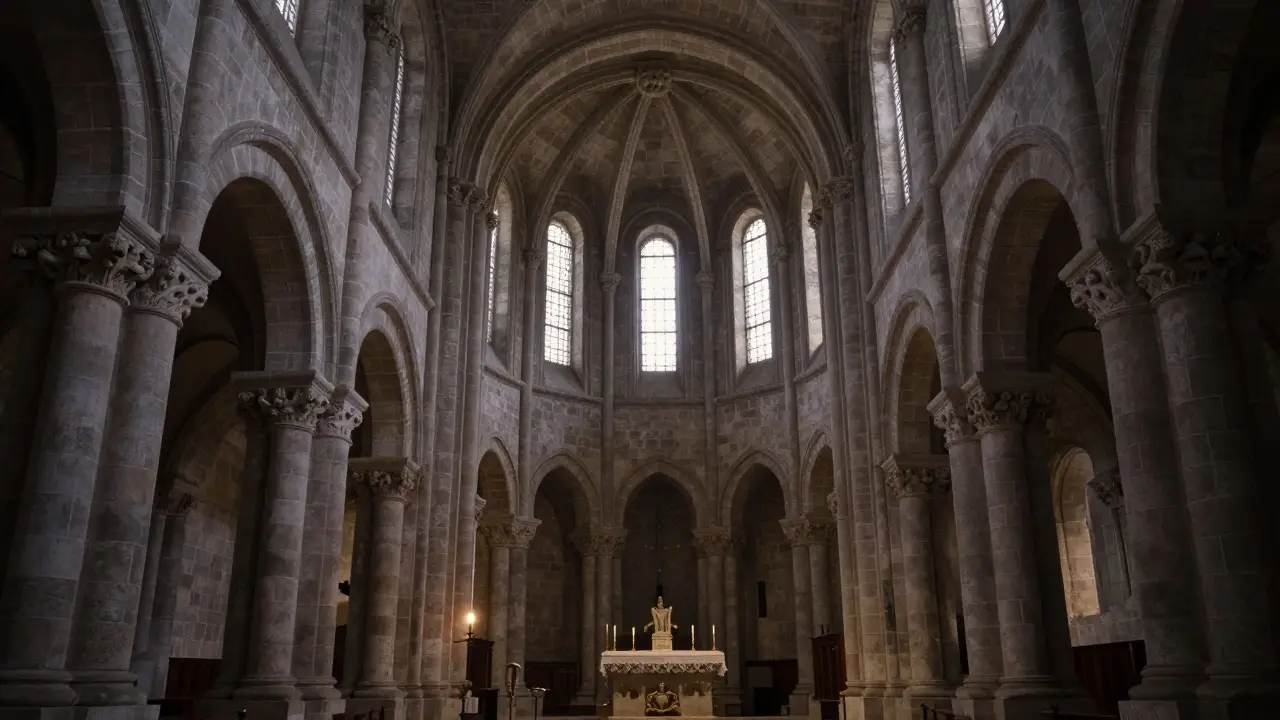
Romanesque architecture isn’t fancy. It doesn’t reach for the sky like Gothic cathedrals later would. It doesn’t dance with light or lace itself with glass. Instead, it digs in. Thick walls. Small windows. Massive pillars. Rounded arches that look like they were borrowed from ancient Rome - which, in a way, they were.
The style emerged across Europe between 800 and 1200 AD, right after the fall of the Carolingian Empire. Towns were small. Roads were dangerous. People needed places that felt safe. Churches weren’t just for worship - they were fortresses, refuges, symbols of order in a chaotic world.
That’s why the walls are so thick. Sometimes over three meters. That’s not excess. That’s necessity. These walls held up heavy stone vaults, blocked arrows, and kept out the cold. Builders didn’t have steel frames or reinforced concrete. They had stone, mortar, and muscle. And they used every bit of it.
The Round Arch: More Than a Shape
The round arch is the signature of Romanesque design. You see it in doorways, windows, arcades inside churches, and even in the vaults above the nave. Unlike pointed Gothic arches that push weight upward, round arches spread it outward. That’s why you need those thick walls - to hold back the lateral force.
It’s a simple idea, but it worked. Builders in Normandy, Tuscany, and the Rhineland all used the same shape. It didn’t matter if they spoke French, Italian, or German. The round arch was universal. It was the building block of a continent-wide style.
And it wasn’t just functional. The rhythm of arches lining a church aisle creates a quiet, repetitive harmony. Walk down a Romanesque nave, and you feel like you’re moving through a stone symphony. Each arch, slightly heavier than the last, pulls your eyes forward - toward the altar, toward the sacred.
Massive Towers and Sculpted Stone
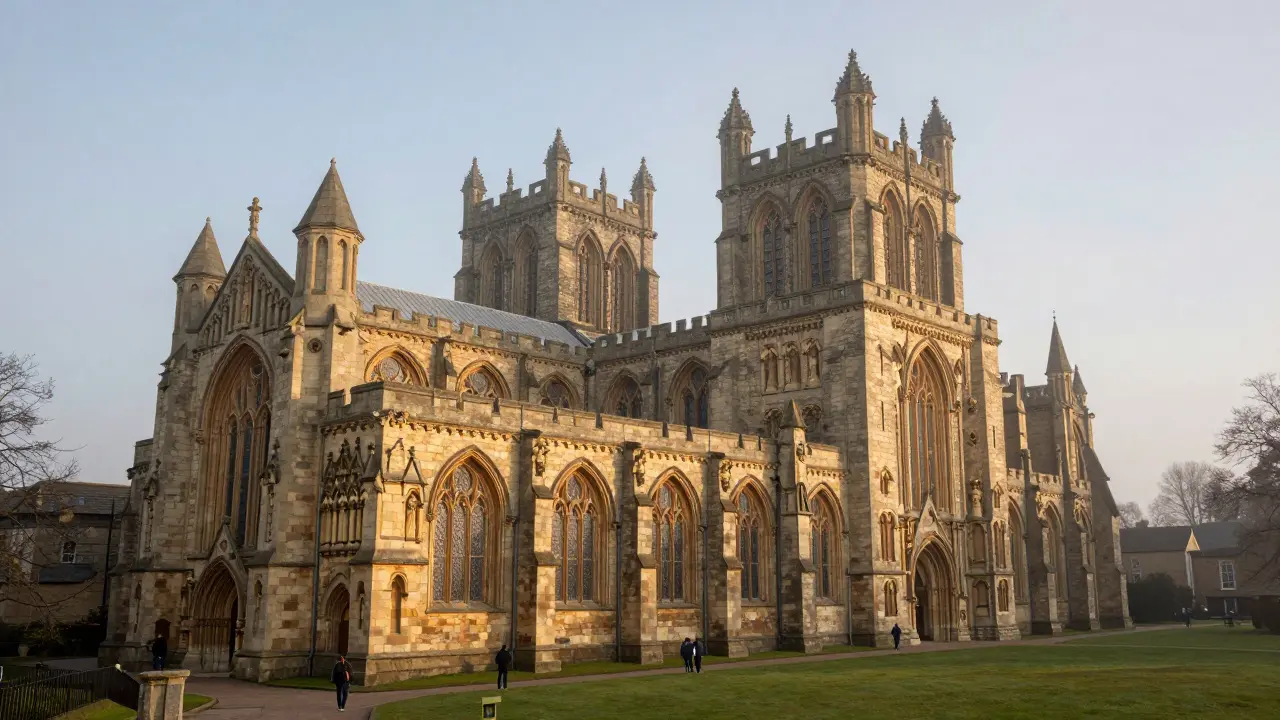
Romanesque churches often have one or two heavy towers. Not tall, not delicate. Solid. Like fists raised to the sky. These weren’t for bells alone. They were statements. A village might not have a castle, but it could have a church tower - visible for miles, a beacon of faith and stability.
The facades were carved with scenes from the Bible. Not subtle carvings. Big, bold figures: Christ in judgment, saints with halos, beasts swallowing sinners. These weren’t decorations. They were sermons in stone. Most people couldn’t read. But they could understand a dragon being crushed under a saint’s foot.
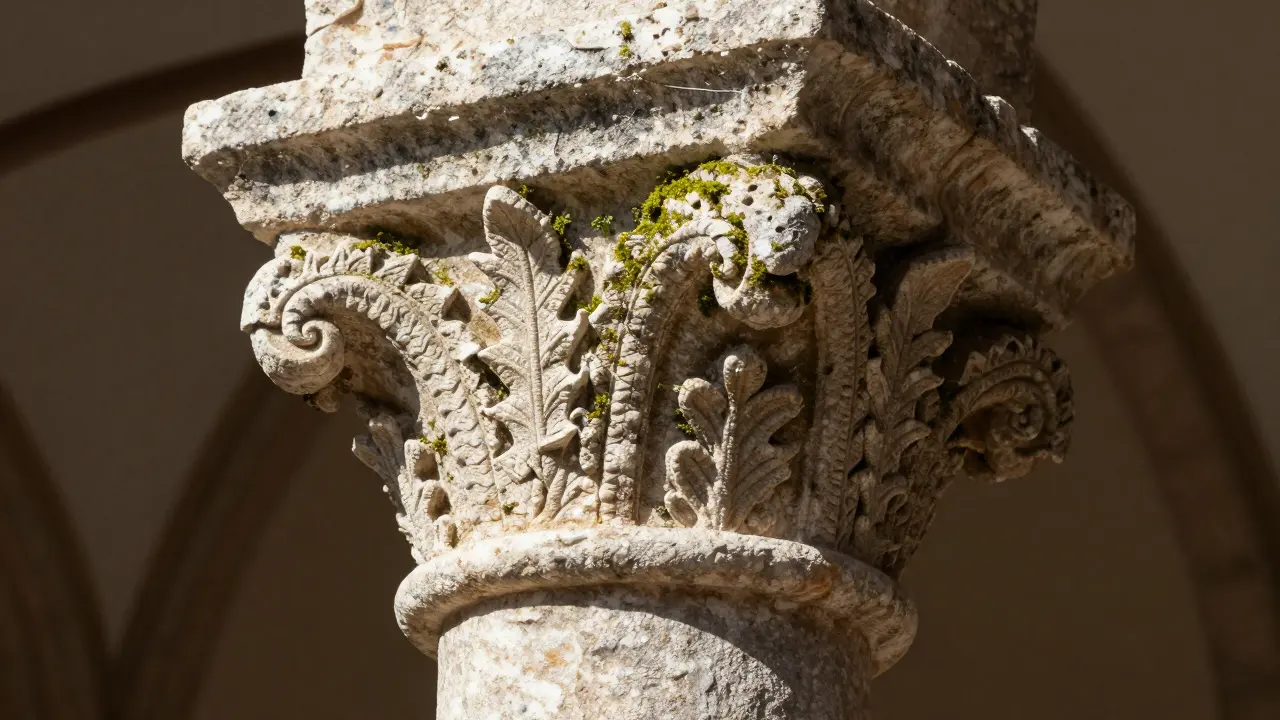
Look closely at the capitals - the tops of columns. You’ll find leaves, lions, dragons, and strange hybrid creatures. Some are biblical. Others are folklore. Some are just the stonemason’s imagination. These weren’t mistakes. They were messages. A reminder that the world was full of mystery, danger, and divine order - all held together by the church.
Stone Vaults: The First Sky Ceilings
Before Gothic ribbed vaults, Romanesque builders used barrel vaults and groin vaults. A barrel vault is like a tunnel of stone stretched across a room. A groin vault is where two barrel vaults cross at right angles, forming a strong, intersecting ridge.
These vaults were heavy. So heavy that they needed thick walls and strong piers. But they changed everything. For the first time, church interiors weren’t just wooden roofs or open timber ceilings. They were enclosed, solid, and vaulted - like underground caves turned sacred.
At the Abbey Church of Sainte-Foy in Conques, France, the barrel vault still stands after 900 years. No steel. No reinforcement. Just stacked stone, perfect mortar, and a thousand hours of labor. That’s the kind of craftsmanship you don’t see anymore.
Why Romanesque Architecture Still Matters
Romanesque buildings weren’t meant to be beautiful in the modern sense. They were meant to be enduring. To outlive kings, wars, and plagues. And they did. Thousands still stand - in rural villages, on pilgrimage routes, in city centers.
Modern architects still study them. Not for ornament. But for honesty. Romanesque builders didn’t hide their structure. They celebrated it. The thickness of the wall, the curve of the arch, the weight of the vault - all were visible, all were necessary.
Today, when we build with glass and steel, we often hide the bones of a building. We put insulation behind walls, ducts in ceilings, supports inside columns. Romanesque architecture says: show the strength. Let the structure speak.
Where to See the Best Examples
You don’t need to travel far to find Romanesque architecture. Here are five places where it’s still alive:
- Speyer Cathedral (Germany) - One of the largest Romanesque churches ever built. Its vaulted nave and twin towers dominate the Rhine Valley.
- Durham Cathedral (England) - The earliest example of pointed ribbed vaulting, a bridge between Romanesque and Gothic styles.
- Santiago de Compostela (Spain) - A pilgrimage church with massive portals, sculpted capitals, and a crypt that’s stood since 1075.
- San Miniato al Monte (Florence, Italy) - A marble-clad church with geometric patterns and a serene, sunlit interior.
- Abbey of Cluny (France, ruins) - Once the largest church in Christendom. Even in ruins, its scale still humbles visitors.
These aren’t museums. They’re still used. People still kneel in them. Choirs still sing in them. The stone still holds the echoes of a thousand prayers.
What Came After
By the 12th century, builders started pushing limits. They wanted taller churches. More light. So they thinned walls, added flying buttresses, and replaced round arches with pointed ones. That’s when Gothic architecture took over.
But Gothic didn’t erase Romanesque. It built on it. The same stone, the same faith, the same need for permanence. Gothic just learned to reach higher.
Romanesque was the foundation. The first time medieval Europe said: we can build something that lasts. Not because we’re clever. But because we’re stubborn. Because we believe in something bigger than ourselves.
Final Thought: Beauty in Endurance
We live in a world of quick fixes. Buildings that last 30 years are called ‘long-lasting.’ We replace phones every two. We scroll past history in seconds.
Romanesque architecture asks us to slow down. To look at the curve of an arch and wonder: who carved this? How did they lift this stone? Why did they spend 50 years building something they’d never see finished?
It’s not about nostalgia. It’s about respect. For craft. For patience. For the quiet power of something built to outlive us all.
What are the main features of Romanesque architecture?
The main features include thick stone walls, small windows, rounded arches, massive piers and columns, barrel or groin vaults, and decorative stone carvings on capitals and facades. Towers are often sturdy and symmetrical, and the overall design emphasizes strength and solidity over height or light.
Why are Romanesque churches so dark inside?
The small windows were necessary to support the heavy stone vaults and thick walls. Larger openings would have weakened the structure. Light came mostly from doorways and a few high clerestory windows, creating a dim, mysterious atmosphere that enhanced the sense of the sacred.
Is Romanesque architecture the same as Norman architecture?
Norman architecture is a regional version of Romanesque, found mainly in England and Normandy after the 1066 conquest. It shares all the core features - round arches, thick walls, massive towers - but often includes more elaborate decoration and larger-scale buildings, like Durham Cathedral. So yes, Norman is a subtype of Romanesque.
How did Romanesque architecture influence later styles?
Romanesque laid the groundwork for Gothic architecture. Builders learned how to support heavy stone roofs, which led to the development of ribbed vaults and flying buttresses. The use of clustered columns and sculpted portals also carried over. Gothic didn’t replace Romanesque - it evolved from it.
Are there any Romanesque buildings outside Europe?
True Romanesque architecture is almost entirely European, tied to medieval Christian building traditions. However, some 19th-century revival buildings in the U.S. and Canada copied Romanesque features - especially the rounded arches and heavy stonework - in churches and public buildings. These are imitations, not original medieval structures.