Renaissance Art: The Birth of a New Perspective
 Mar, 2 2026
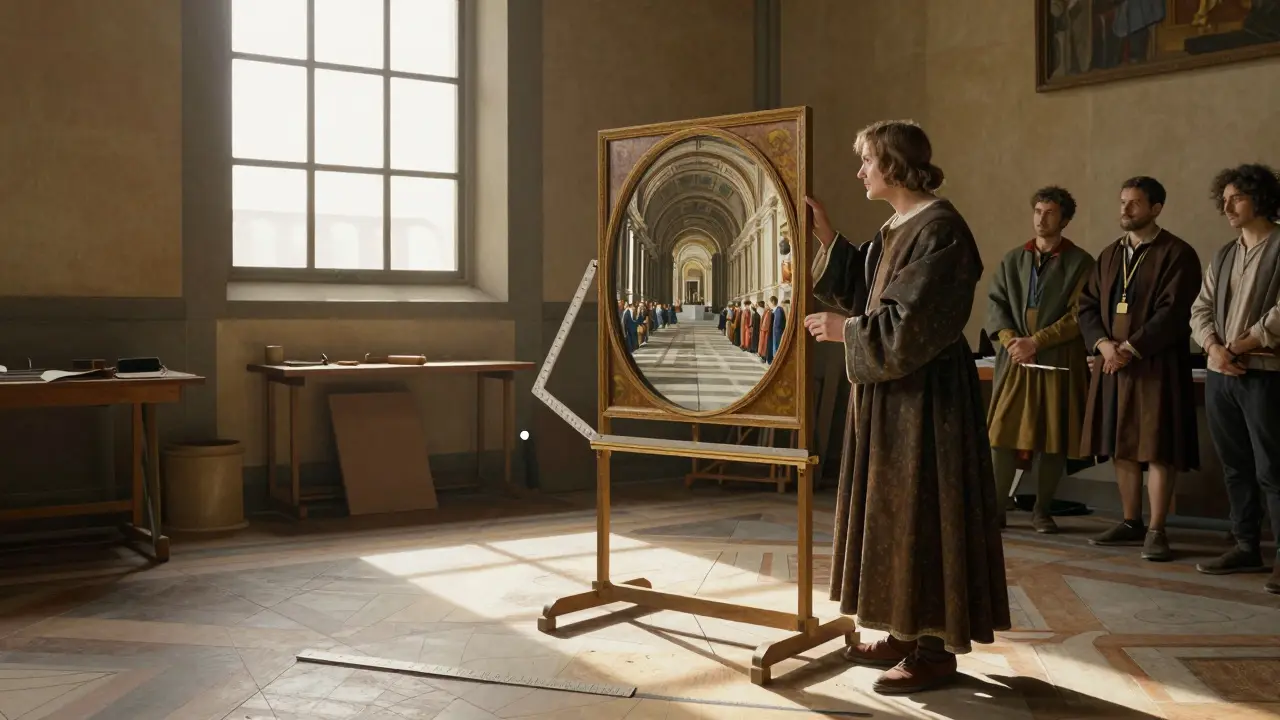
Before the 1400s, paintings looked flat. Figures floated in space. Backgrounds were gold leaf or plain color. No depth. No realism. Then, in Florence, something changed. A painter named Brunelleschi is an Italian architect and engineer who demonstrated the mathematical system of linear perspective around 1415. Also known as Filippo Brunelleschi, he used a mirror and a painted panel to prove that parallel lines converge at a single point on the horizon. That moment didn’t just change art-it rewrote how humans saw the world.
What Was Lost Before the Renaissance
Medieval art wasn’t bad. It just had different goals. Icons, altarpieces, and frescoes weren’t meant to trick the eye. They were meant to show divine truth. Saints were bigger than kings. Buildings were symbolic, not structural. Space didn’t matter because heaven wasn’t a place you could map.
Then came the Black Death. Cities rebuilt. Universities reopened. People started asking: Why not study the real world? Why not look at how light falls on a hand? How shadows stretch across stone? This wasn’t just about technique. It was a shift in thinking-humanism is a philosophical movement during the Renaissance that placed human experience, reason, and classical antiquity at the center of culture. Also known as Renaissance humanism, it drew inspiration from Greek and Roman texts, emphasizing individual potential and secular life. Art began to reflect people, not just saints.
The Breakthrough: Linear Perspective
Brunelleschi didn’t just draw lines. He proved a rule: if you stand in one spot and look at a scene, all parallel lines-like the edges of a floor tile or the sides of a building-appear to meet at one point on the horizon. That’s the vanishing point. He painted a panel of the Baptistery in Florence, drilled a hole in it, and used a mirror to show viewers the illusion was perfect.
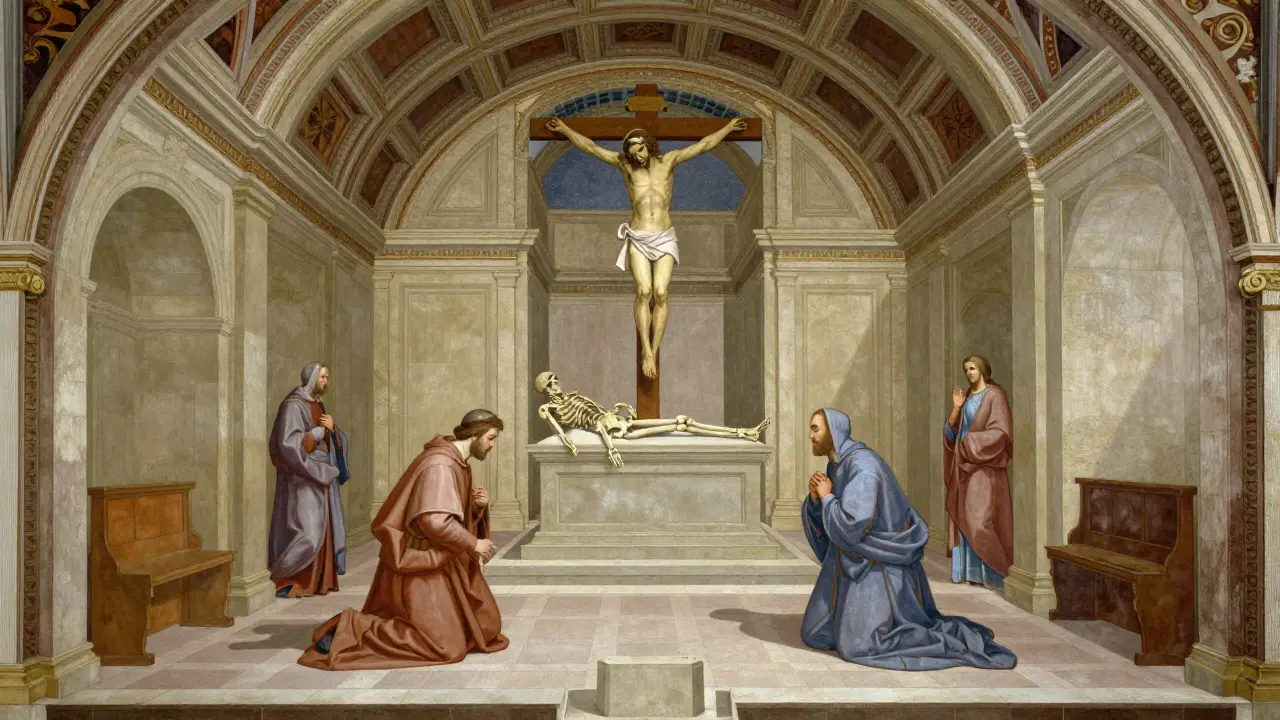
His student, Masaccio is an Italian painter who applied Brunelleschi’s perspective to fresco painting in the early 15th century. Also known as Tommaso di Ser Giovanni di Mone Cassai, he was one of the first to use perspective to create believable space in religious scenes, took this further. In his painting The Holy Trinity (1427), he painted a chapel with coffered ceilings and a vaulted tomb. The figures stand in real space. You can almost walk into the scene. That painting shocked people. It looked like a window into another world.
Before Masaccio, figures were arranged like a row of statues. After him, they stood on floors, leaned against walls, cast shadows. Depth became a tool to tell stories better. A grieving mother wasn’t just symbolic-she was in a room, with real architecture around her.
How It Spread Across Italy
Perspective didn’t stay in Florence. Artists copied it. Traveled. Taught. Leonardo da Vinci is a Renaissance polymath who studied optics, anatomy, and perspective to create lifelike compositions. Also known as Leonardo di ser Piero da Vinci, he documented perspective in notebooks and used it to make figures feel physically present spent years sketching how light hits eyes, how heads turn in space. He didn’t just paint-he measured. His Last Supper isn’t just a scene. It’s a stage. The room recedes. The apostles sit on benches that follow the vanishing point. Christ is the center-not because he’s glowing, but because the lines all lead to him.
In Venice, Giovanni Bellini is a Venetian painter who blended linear perspective with atmospheric color to create emotionally rich scenes. Also known as Giovanni di Bartolomeo Bellini, he influenced Titian and helped shift focus from structure to mood used perspective differently. His landscapes didn’t scream geometry. They breathed. Mountains faded into mist. Water shimmered with reflected light. He proved perspective wasn’t just about lines-it could carry emotion.
Why This Changed Everything
Art wasn’t just prettier. It became a new way of knowing. Perspective wasn’t just a trick. It was proof that the world could be understood through observation. That idea spilled into science, politics, even religion.
Before, truth came from scripture. After, truth came from looking. Galileo used the same logic-measure, test, repeat. Architects began designing buildings based on proportion, not just tradition. City planners started mapping streets with grids. Even the idea of the individual changed. You weren’t just a soul in God’s plan. You were a person in a real world, with a place, a shadow, a point of view.
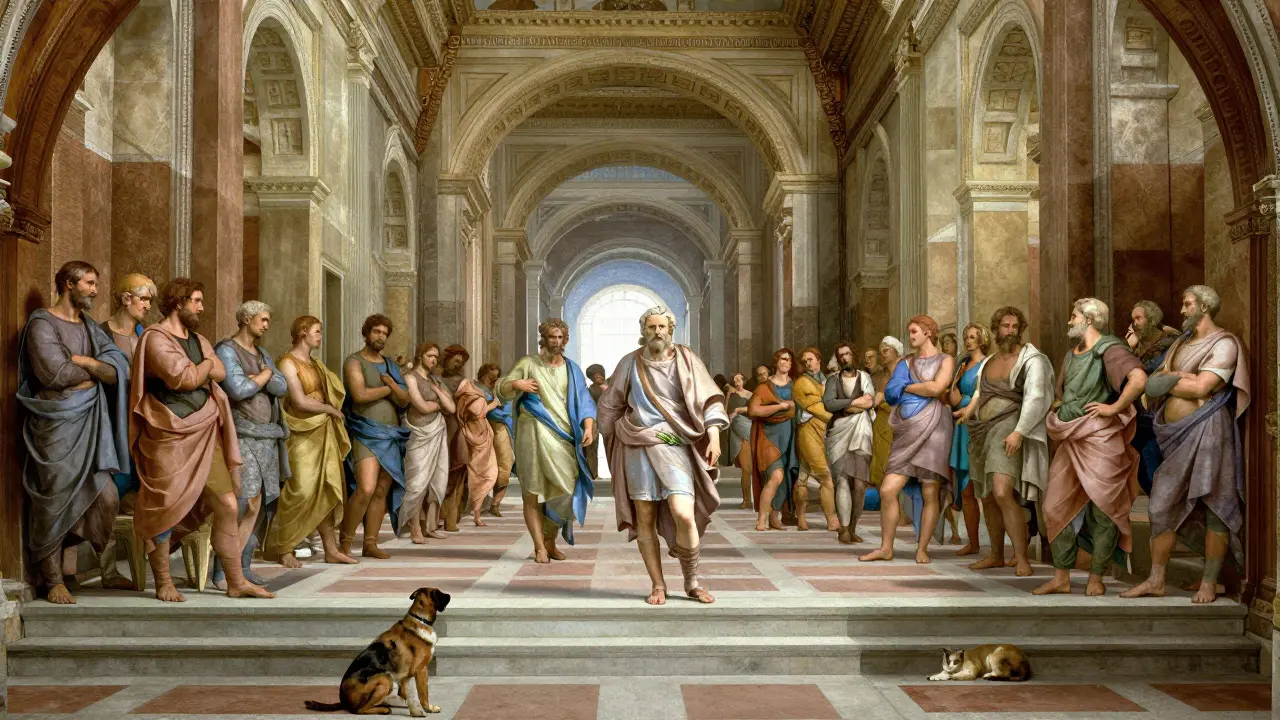
By the time Raphael painted The School of Athens (1509), perspective was second nature. The grand hall stretches into infinity. Plato and Aristotle walk toward the vanishing point. Scholars stand on marble floors that lead your eye straight to them. The painting doesn’t just show philosophy-it makes you feel like you’re there.
What Happened After
By the 1550s, perspective was everywhere. But artists didn’t stop there. They started bending it. Caravaggio used extreme angles to make scenes feel urgent. Rembrandt played with light to hide or reveal emotion. The rules became tools, not chains.
But the core idea stayed: the world could be seen, measured, and understood. That’s why Renaissance perspective matters today. It’s not just in museums. It’s in your smartphone camera. In 3D video games. In movie scenes that pull you into a room. The same math that Brunelleschi sketched on a wall is now in your Instagram filters.
The Legacy You Can Still See
Walk into any modern museum. Look at a Renaissance painting. Notice how the floor tiles angle toward the center. How the windows line up with the edges of a table. How a hand reaches out, and you can almost touch it. That’s not magic. That’s math. That’s observation. That’s the birth of a new way of seeing.
You don’t need to be an artist to feel it. You just need to look. The next time you see a photo with perfect depth-buildings shrinking in the distance, a road leading to a horizon-that’s the Renaissance speaking to you. Not from a painting. From your own eyes.
What was the main breakthrough in Renaissance art?
The main breakthrough was linear perspective-a mathematical system that created the illusion of depth on a flat surface. Developed by Brunelleschi and first applied in painting by Masaccio, it allowed artists to depict space realistically, making scenes feel three-dimensional and immersive.
Who was the first artist to use linear perspective in painting?
Masaccio was the first painter to apply Brunelleschi’s perspective system in his fresco The Holy Trinity (c. 1427). His use of vanishing points and proportional scaling created the illusion of a chapel receding into space, shocking viewers with its realism.
How did humanism influence Renaissance art?
Humanism shifted focus from religious symbolism to human experience. Artists began studying anatomy, emotion, and the natural world. Figures were no longer stiff icons but individuals with weight, movement, and expression. This led to more lifelike portraits, realistic landscapes, and scenes set in believable spaces.
Did all Renaissance artists use perspective the same way?
No. While Florentine artists like Masaccio and Uccello focused on precise geometry, Venetian painters like Bellini and Titian used perspective more loosely to enhance mood. Some, like Leonardo, combined perspective with atmospheric effects-hazy backgrounds and soft shadows-to create depth without rigid lines.
Is linear perspective still used today?
Yes. It’s the foundation of modern visual media. From photography and film to video games and 3D modeling, the same rules of vanishing points and horizon lines are used to create realistic depth. Even smartphone cameras and VR headsets rely on the principles first proven in 15th-century Florence.