Postmodern Architecture: Breaking the Rules of Design
 Apr, 20 2026
We are talking about Postmodern Architecture is an architectural style that emerged in the 1960s as a reaction against the austerity and perceived sterility of Modernism. Unlike its predecessor, it doesn't care about strict rules or purity. Instead, it embraces irony, bright colors, and a wild mix of historical styles. It turned architecture back into an art form that talks to people, rather than just serving a function.
The Great Rebellion Against the Glass Box
To get why this movement happened, you have to understand what it was fighting. Modernism-think of the International Style-wanted everything to be efficient. They stripped away ornaments, used raw concrete, and focused on the grid. While this worked for factories and offices, people started feeling like they were living in a sterile lab. The cities began to look identical, whether you were in New York, Tokyo, or Berlin.
By the late 1960s, architects were tired of the silence. They wanted buildings to have a personality again. This is where Robert Venturi comes in. He basically threw a grenade into the architectural world with his book "Complexity and Contradiction in Architecture." He argued that architects should embrace the messy, confusing nature of the real world instead of trying to simplify everything into a cube.
Venturi's big idea was that buildings should communicate. He introduced the concept of the "decorated shed"-the idea that a building's function can be simple, but its exterior should be a billboard that tells a story or references the past. This shifted the focus from how a building is made to what it says to the person walking by.
The Toolkit of the Postmodernist
How do you actually "do" Postmodernism? It's not about following a manual; it's about raiding a museum of every style ever created and picking the bits that look cool together. This is called eclecticism. You might see a sleek glass facade paired with a giant Greek column made of neon-colored plastic. It's essentially a mashup culture applied to steel and stone.
One of the biggest hallmarks is the use of historical quotation. This isn't about accurately recreating a Gothic cathedral; it's about "quoting" a pointed arch or a gargoyle and placing it in a way that feels playful or sarcastic. It's architectural sampling. By mixing high-art elements with pop-culture vibes, these buildings break the tension between the elite world of design and the everyday experience of the street.
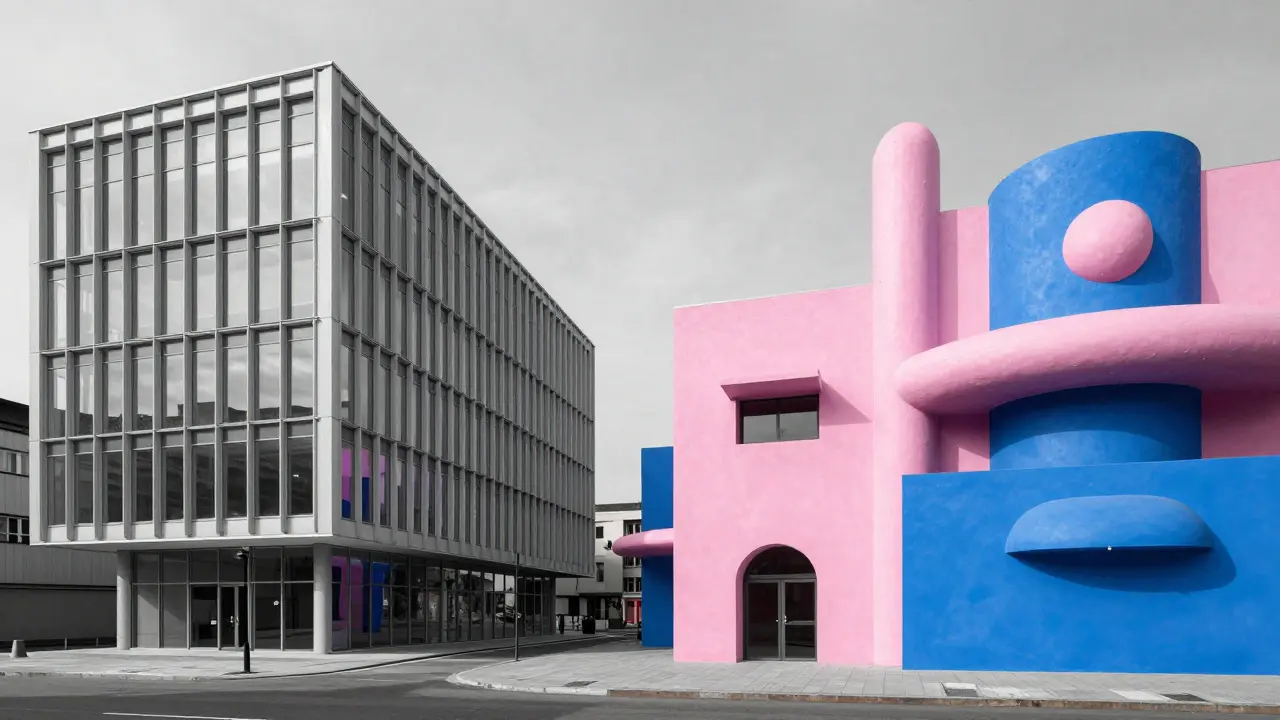
Then there's the color palette. While Modernists loved gray, white, and black, Postmodernists went for the bold stuff. Think pastel pinks, electric blues, and bright yellows. They used these colors to highlight specific parts of a building, often making the structure feel less like a monolith and more like a sculpture.
| Feature | Modernism (The Predecessor) | Postmodernism (The Rebel) |
|---|---|---|
| Motto | "Less is more" | "Less is a bore" |
| Aesthetics | Minimalist, Geometric | Eclectic, Ornamental |
| Color | Neutral, Raw Materials | Vibrant, Contrasting |
| Philosophy | Universalism (One style for all) | Pluralism (Many styles for many) |
| Reference | Future-facing, No history | Historical citations and irony |

The Mavericks Who Changed the Skyline
You can't talk about this movement without mentioning Philip Johnson. He was once the poster boy for the International Style, but then he did a total 180. In 1984, he completed the AT&T Building in New York. Instead of a flat top, he gave the skyscraper a top that looked like a piece of 18th-century furniture. It was a scandal at the time, but it proved that skyscrapers didn't have to be boring boxes.
Another giant in this space was Michael Graves. His work, like the Portland Building, looks almost like a giant painting. He used oversized shapes and exaggerated colors to make the building feel like a piece of public art. He didn't just want to build an office; he wanted to create a landmark that felt welcoming and whimsical.
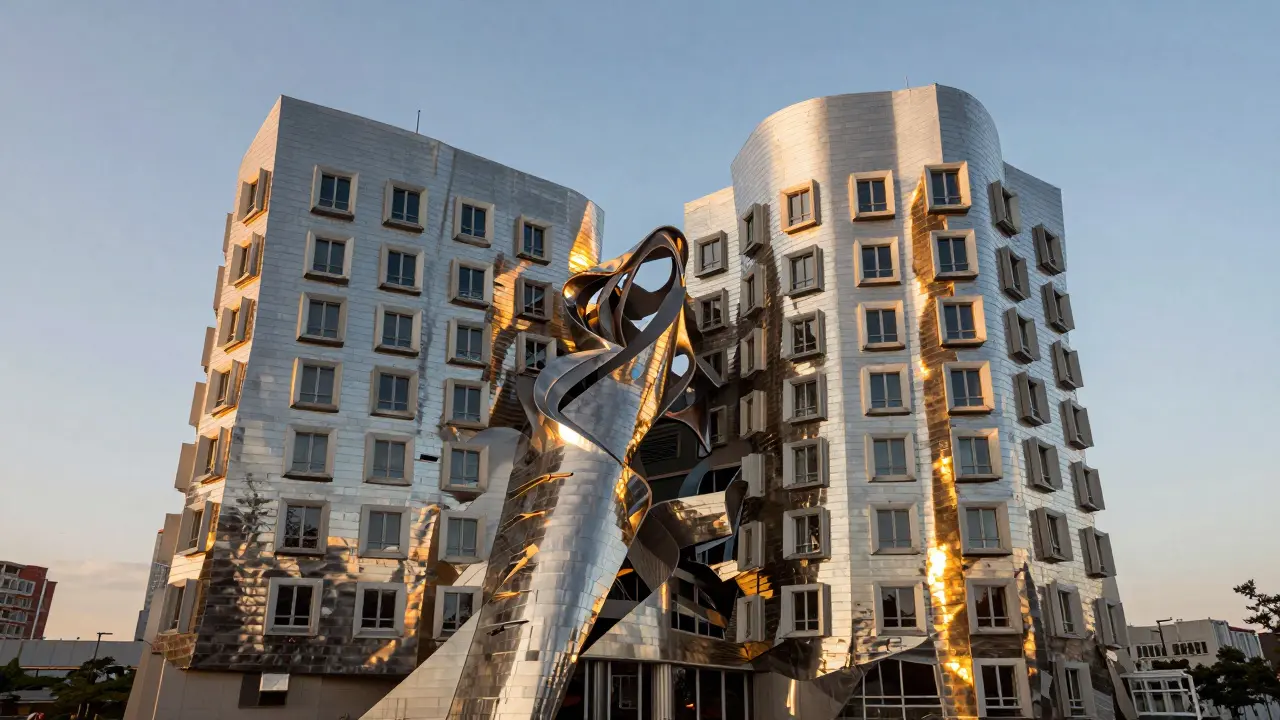
As the movement evolved, it pushed further into the weird and wonderful, leading to Deconstructivism. This is like Postmodernism on steroids. Architects like Frank Gehry started designing buildings that looked like they were exploding or being twisted by a giant hand. Look at the Guggenheim Museum in Bilbao-it's a swirl of titanium that defies every traditional rule of geometry. While some call it chaotic, it's actually a highly calculated experiment in how materials can be pushed to their limit.
Why This Experimental Art Actually Matters
Some people look at Postmodern buildings and think they're just "ugly" or "tacky." But the value isn't in the beauty-it's in the freedom. Postmodernism taught us that architecture doesn't have to be a monolith. It gave permission for architects to be funny, to be sentimental, and to be contradictory.
It also brought back the idea of context. Modernism tried to build the same way everywhere, regardless of whether the building was in a desert or a forest. Postmodernism encouraged designers to look at the surrounding neighborhood and incorporate local elements. This created a bridge between the new world and the old world, making cities feel more like a layered history book than a sterile grid.
Moreover, this movement paved the way for the digital revolution in design. The wild shapes of Deconstructivism wouldn't be possible without advanced software like CAD (Computer-Aided Design). The willingness to experiment with form and function in the 70s and 80s directly influenced the parametric architecture we see today, where buildings are shaped by algorithms rather than just a ruler and a pencil.
Pitfalls and the "Kitsch" Problem
It wasn't all sunshine and neon. Because Postmodernism encouraged "borrowing" from the past, some architects went too far. They started adding fake columns and plastic moldings that looked cheap, leading to a style often called "kitsch." When a building tries too hard to be ironic or "fun," it can end up looking like a theme park attraction rather than a professional structure.
There was also a struggle with longevity. Some of the materials used in the early Postmodern era-like certain types of colorful cladding-didn't age well. We've seen buildings from the 80s that look faded and worn, which ironically makes them feel more "modern" in a decaying way. The challenge was always balancing the desire for playfulness with the need for a building to actually last a hundred years.
How to Spot a Postmodern Building in the Wild
If you're walking through a city and aren't sure if you're looking at a Postmodern piece, look for these red flags:
- Mixed Signals: Does it have a glass wall but also a weirdly placed stone arch?
- Odd Proportions: Are the windows unusually small or huge? Is there a massive decorative element that serves no purpose?
- Color Pops: Is there a random strip of teal or peach paint on a concrete wall?
- Symmetry (or lack thereof): Does the building look like it was sliced in half and put back together slightly off-center?
- Irony: Does it look like it's making fun of a traditional style?
Is Postmodern architecture still popular today?
Not in its pure "neon and pastel" form, but its spirit lives on. Today's architects use its philosophy of eclecticism and mixing styles, but they blend it with sustainability and smarter materials. We've moved from purely visual irony to "Neo-Postmodernism," which is more about emotional connection and environmental context than just looking weird.
What is the difference between Postmodernism and Deconstructivism?
Think of Postmodernism as the parent and Deconstructivism as the rebellious teenager. Postmodernism plays with historical styles and colors but usually keeps the building's basic structure intact. Deconstructivism goes further by literally "deconstructing" the shape-breaking the geometry, tilting walls, and making the building look unstable or fragmented.
Who are the most important Postmodern architects?
The key figures include Robert Venturi, who provided the theoretical foundation; Philip Johnson, who brought it to the corporate skyline; Michael Graves, known for his whimsical, colorful public works; and Frank Gehry, who pushed the movement into the realm of sculptural, fluid shapes.
Why is it called "Post" Modernism?
The "Post" signifies that it comes after the era of Modernism. It's not just a chronological marker; it's a critique. It means "after the failure of the modern dream," acknowledging that the strict, universal rules of Modernism didn't satisfy the human need for variety and meaning.
Does Postmodern architecture have a specific geographic center?
While it started strongly in the United States-specifically in cities like New York and Los Angeles-it quickly became a global phenomenon. You can find iconic Postmodern examples in Europe, Japan, and South America, as it gave architects everywhere a way to break free from the globalized "International Style."