How Deconstructivism Changed the Way Cities Look
 Mar, 23 2026
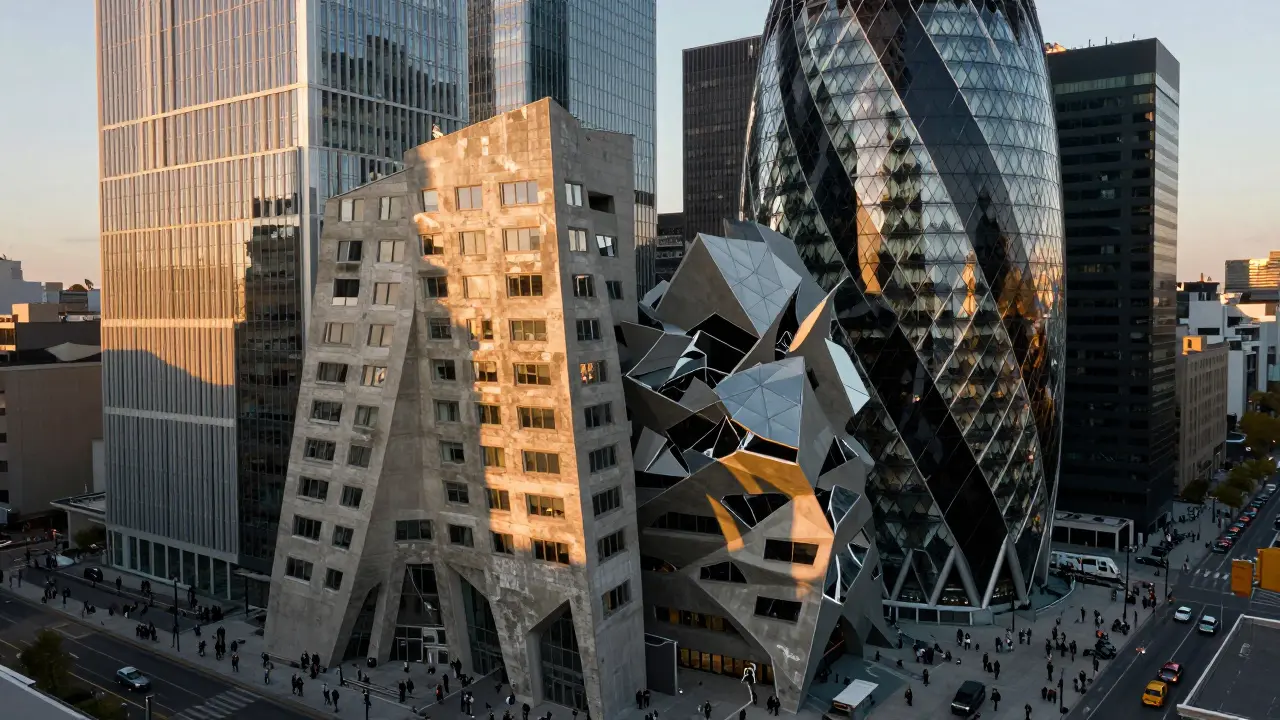
Walk through any major city today, and you’ll see buildings that look like they were dropped from a collapsing puzzle. Angled walls, tilted floors, twisted steel frames - these aren’t accidents or broken structures. They’re intentional. This is deconstructivism, a movement that didn’t just add new buildings to cities - it rewrote the rules of what a building could be.
What Deconstructivism Really Is
Deconstructivism didn’t come out of nowhere. It grew from the ideas of philosopher Jacques Derrida, who argued that meaning in language isn’t fixed - it’s unstable, broken, and open to interpretation. Architects took that idea and turned it into concrete and glass. Instead of symmetry, balance, and order, deconstructivist buildings embrace chaos, distortion, and tension.
It’s not just about looking weird. It’s about challenging the idea that buildings should serve function in a clean, predictable way. A deconstructivist structure might look like it’s falling apart, but every jagged edge is calculated. The goal isn’t to confuse - it’s to make you question why buildings look the way they do.
Unlike modernism, which stripped everything down to pure form, or postmodernism, which playfully borrowed historical styles, deconstructivism refuses to settle into any category. It’s architecture that fights against itself.
The Buildings That Changed Cities
Some buildings don’t just sit in a city - they redefine it. The Vitra Design Museum in Germany, designed by Frank Gehry, looks like a group of white cubes that got hit by a storm. Its curves and sharp angles don’t follow any traditional grid. People didn’t just visit it - they started photographing it, talking about it, arguing over it.
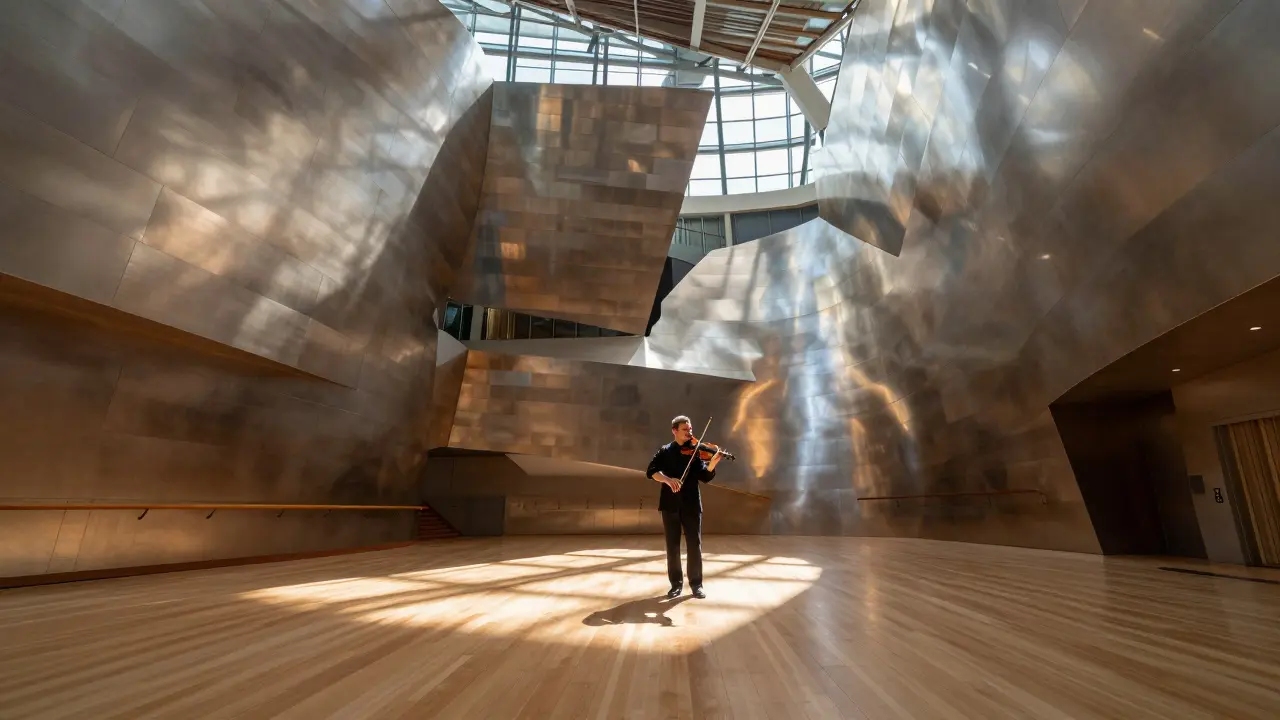
In Barcelona, the Walt Disney Concert Hall by Gehry again. Its stainless steel surface reflects sunlight like a ship’s hull, and its curves bend the sound of the orchestra in ways traditional halls never could. The building didn’t just become a concert hall - it became a landmark that reshaped how people moved through the neighborhood.
Then there’s the Julia Stoschek Collection in Berlin, with its fractured façade that looks like a building caught mid-explosion. Or the CCTV Headquarters in Beijing, a loop of steel that defies gravity and logic. These aren’t just offices - they’re statements. They force the city to adapt around them.
These buildings didn’t just add to the skyline. They forced planners to rethink zoning, traffic flow, and even public safety. A deconstructivist tower might cast unpredictable shadows that block sunlight for hours. Its uneven surfaces might create wind tunnels at street level. Cities had to learn how to live with architecture that refused to behave.
Why Cities Struggled to Adapt
Before deconstructivism, urban planning was about predictability. Streets ran straight. Buildings aligned. Public spaces were orderly. But deconstructivist architecture threw all that out.
Take the Liberty Place complex in Philadelphia. When the first deconstructivist tower went up in the late 1980s, city officials didn’t know how to classify it. Was it a skyscraper? A sculpture? A hazard? Zoning codes didn’t have rules for buildings that leaned at 23 degrees. Fire escapes couldn’t be installed normally. Elevator shafts had to be reengineered because the floor levels weren’t parallel.
Insurance companies refused to cover some deconstructivist buildings because their structural risks couldn’t be modeled. City inspectors had no checklist for curved concrete that looked like it was melting. In many cases, these buildings were approved only after lawsuits, public protests, or last-minute engineering revisions.
And yet, despite the chaos, they stuck. Why? Because they drew attention. Tourists came. Businesses opened nearby. Real estate values rose. A deconstructivist building became a magnet - not because it was comfortable, but because it was unforgettable.
The Ripple Effect on Urban Design
Deconstructivism didn’t stop at individual buildings. It changed how entire districts were planned.
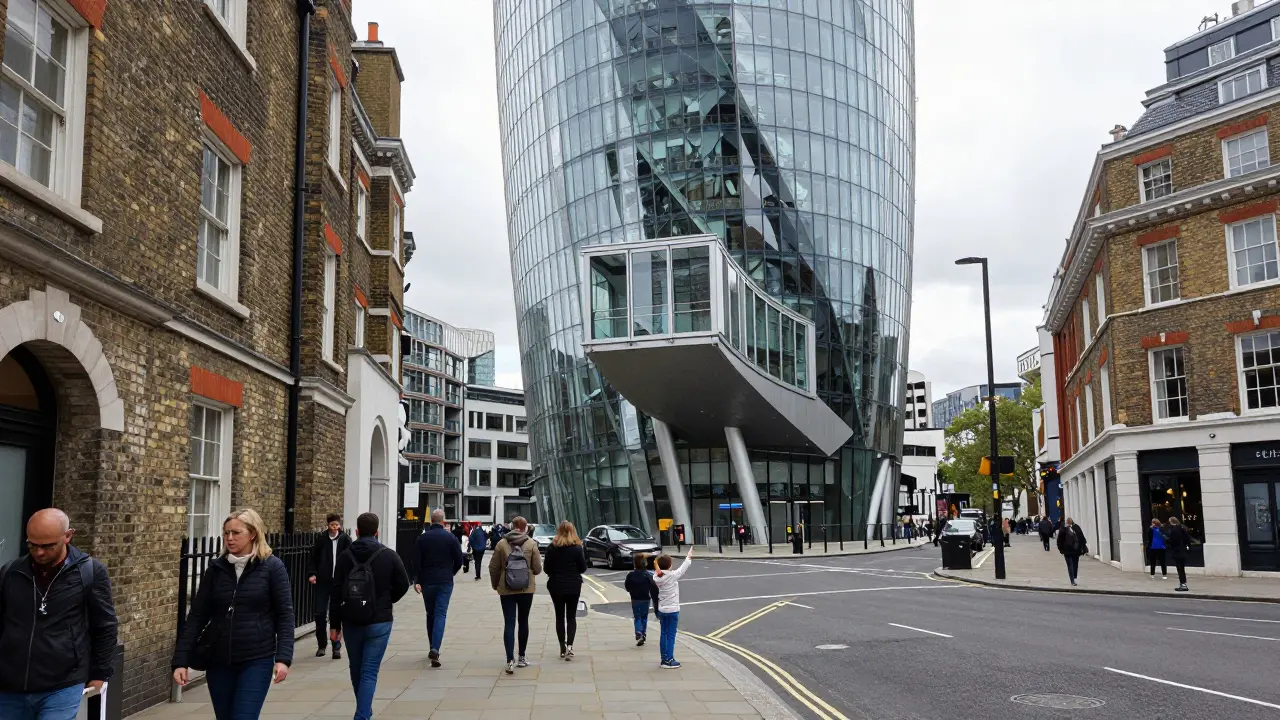
Before, urban design focused on harmony - buildings that matched in height, material, and rhythm. But deconstructivism introduced the idea that contrast could be intentional. In London’s King’s Cross redevelopment, architects deliberately mixed deconstructivist facades with Victorian brickwork. The clash wasn’t an accident - it was the point.
Public spaces changed too. Instead of flat plazas and symmetrical fountains, you started seeing uneven pavements, tilted benches, and staircases that led nowhere. These weren’t design flaws - they were invitations to explore. People stopped walking in straight lines. They paused, looked up, turned around.
Even sidewalks adapted. In Shanghai’s West Bund district, curving walkways were built to guide people around a deconstructivist art center. The path didn’t follow the grid - it followed the building’s energy. That kind of thinking spread. Urban planners began designing for movement, not just efficiency.
Deconstructivism vs. Other Styles
It’s easy to confuse deconstructivism with other modern styles. But here’s how it’s different:
| Feature | Deconstructivism | Modernism | Postmodernism |
|---|---|---|---|
| Form | Fragmented, distorted, unstable | Simple, geometric, functional | Playful, historical references |
| Goal | Challenge order and symmetry | Promote efficiency and purity | Reintroduce ornament and meaning |
| Material Use | Steel, concrete, glass - often raw | Steel, glass, concrete - polished | Brick, tile, color - decorative |
| Public Reaction | Polarizing, often controversial | Seen as cold or sterile | Seen as gimmicky or ironic |
| Example | Walt Disney Concert Hall, a curving, stainless-steel building in Los Angeles designed by Frank Gehry | Seagram Building, a glass-and-steel tower in New York by Mies van der Rohe | Portland Building, a colorful, ornate structure in Oregon by Michael Graves |
Modernism wanted to solve problems. Postmodernism wanted to joke about them. Deconstructivism wanted to unsettle them.
Deconstructivism Today
Is deconstructivism still alive? Yes - but not as a movement. It’s now a tool.
Young architects don’t call themselves deconstructivists anymore. But you’ll see its DNA in almost every bold urban project. The Beijing National Stadium (the Bird’s Nest) uses twisted steel in ways that echo deconstructivist principles. The Heydar Aliyev Center in Baku looks like it’s made of liquid stone - no straight lines, no corners, no rules.
Even affordable housing projects are borrowing from it. In Vienna, a new social housing complex uses angled balconies and staggered floors not for style, but to create private outdoor spaces in dense neighborhoods. The shape isn’t decorative - it’s functional. But it came from deconstructivist thinking.
Technology helped. 3D modeling, parametric design, and advanced materials made it possible to build what was once impossible. What used to be radical is now just another option on the table.
Why It Still Matters
Deconstructivism didn’t win because it was beautiful. It won because it forced cities to evolve.
Before it, urban design was about control. After it, cities learned to embrace unpredictability. A building didn’t have to be perfect to be valuable. It didn’t have to fit in to matter.
Today’s most vibrant neighborhoods - from Tokyo’s Shibuya to Mexico City’s Roma - have a mix of styles, ages, and shapes. That’s not chaos. That’s the legacy of deconstructivism. It taught us that cities aren’t machines. They’re living things - messy, unpredictable, and alive.
Is deconstructivism just about making buildings look crazy?
No. While deconstructivist buildings often look chaotic, every distortion is intentional. The goal isn’t to shock - it’s to challenge how we think about space, function, and order. A tilted wall might create better natural light. A twisted staircase might encourage people to move through a building in unexpected ways. It’s design with purpose, not just drama.
Can deconstructivism be used in residential buildings?
Yes - but it’s rare. Most deconstructivist buildings are cultural or institutional because they’re expensive and complex. However, some high-end homes use deconstructivist elements: irregular floor plans, cantilevered decks, asymmetrical windows. These homes aren’t meant for mass production - they’re one-offs designed for clients who want to live in a piece of architecture, not just a house.
Why do some cities reject deconstructivist buildings?
Many cities struggle with the cost and complexity. Deconstructivist buildings often require custom engineering, specialized materials, and longer construction times. They can also create safety issues - uneven surfaces, wind tunnels, or shadow patterns that affect solar access. Some cities avoid them because they’re hard to maintain or because they don’t fit zoning rules designed for traditional forms.
Who are the key architects of deconstructivism?
Frank Gehry is the most famous, with buildings like the Walt Disney Concert Hall. Zaha Hadid pushed the movement further with fluid, futuristic forms like the Heydar Aliyev Center. Daniel Libeskind’s Jewish Museum in Berlin and Rem Koolhaas’s CCTV Building in Beijing are also landmark examples. These architects didn’t just design buildings - they redefined what architecture could express.
Is deconstructivism still relevant in 2026?
Not as a labeled style - but its influence is everywhere. Today’s architects don’t call themselves deconstructivists, but they use its principles: breaking symmetry, challenging grids, and embracing irregularity. With AI-driven design tools, even small projects now play with complex forms that would’ve been impossible 30 years ago. Deconstructivism didn’t disappear - it became normal.
Deconstructivism didn’t just change buildings. It changed how we think about cities. It taught us that beauty doesn’t always mean harmony - sometimes, it means tension. And sometimes, the most powerful spaces aren’t the ones that fit in - they’re the ones that refuse to.