Greek Revival Architecture: The American Style That Shaped Democracy
 Sep, 7 2026
You walk past a white building with tall, imposing columns and a triangular roof. You assume it’s a museum or a bank. But here is the twist: most of these structures weren’t built to house art or money. They were built to scream "Democracy." Greek Revival architecture is a neoclassical architectural style that flourished in the United States from roughly 1825 to 1860, characterized by its use of Greek temple forms like pediments, columns, and entablatures. It wasn’t just an aesthetic choice; it was a political statement made in stone and wood. Why did a young nation obsessed with Rome suddenly pivot to Athens? And how did this style change the way we build public spaces today?
The Political Statement Behind the Columns
Before the 1820s, America looked to Rome. The Federal style is an early American architectural style that drew heavily on Roman and Italian Renaissance designs, featuring symmetry, fanlights, and delicate ornamentation. dominated the landscape. Think of the White House or Monticello. These buildings signaled stability, empire, and order. But after the War of 1812, something shifted. Americans began to feel a stronger connection to ancient Greece than to imperial Rome. Why? Because Greece represented democracy, philosophy, and the birth of Western civilization. Rome, conversely, felt like monarchy and conquest.
This shift wasn’t subtle. Architects started stripping away the ornate details of the Federal era. They wanted raw power. They wanted the stark, geometric purity of the Parthenon. When you look at a Greek Revival home, you aren’t just seeing decoration. You are seeing a citizen declaring their allegiance to republican ideals. This movement coincided with the rise of Andrew Jackson and the expansion of voting rights to all white men. The architecture matched the politics: bold, direct, and unapologetically democratic.
Anatomy of the Style: What Makes It Greek?
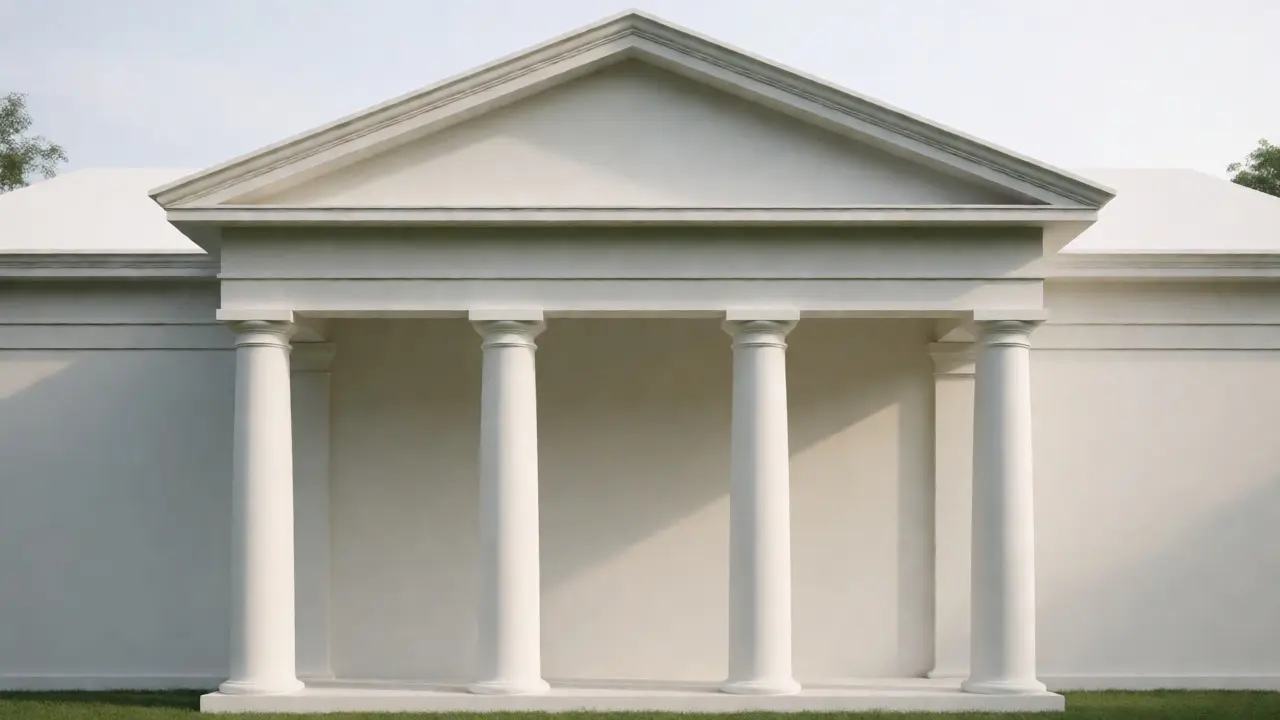
How do you spot a Greek Revival building if you don’t have a history degree handy? It’s actually quite simple once you know what to look for. Unlike the curved arches of Roman styles, Greek Revival relies entirely on straight lines and right angles. The defining feature is the temple front is the facade of a building designed to mimic the entrance of an ancient Greek temple, typically featuring a row of columns supporting a triangular pediment..
Here are the non-negotiable elements:
- The Pediment: That triangular gable end facing the street. In earlier styles, the long side of the house faced the road. In Greek Revival, the short end faces you, turning the house into a miniature temple.
- Columns: Usually four or six, placed directly under the pediment. They are rarely structural anymore; they are purely decorative props holding up the visual weight of the roof.
- Entablature: The horizontal beam resting on top of the columns. It often features a plain frieze (the middle band) rather than intricate carvings.
- Wide Eaves: Deep overhangs that cast strong shadows, emphasizing the horizontal lines.
Notice the absence of brick patterns or decorative ironwork. If you see a porch with fancy scrollwork, it’s probably not Greek Revival. If you see a flat, heavy beam supported by smooth pillars, you’re getting closer.
The Order of Choice: Doric vs. Ionic vs. Corinthian
Not all Greek columns are created equal. The architects of the 19th century had three main options, each carrying different symbolic weight. Choosing the wrong one could send the wrong message about your wealth or taste.
| Order | Visual Characteristics | Symbolic Meaning | Common Use Case |
|---|---|---|---|
| Doric | Plain capital, no base, fluted shaft, sturdy proportions. | Masculinity, strength, simplicity, military virtue. | Public buildings, banks, modest homes. |
| Ionic | Scroll-like volutes on capital, slender shaft, sits on a base. | Elegance, intellect, femininity, refinement. | Libraries, courthouses, larger estates. |
| Corinthian | Elaborate acanthus leaf decoration, very slender, highly ornate. | Wealth, luxury, grandeur, imperial ambition. | Rarely used in true Greek Revival; more common in later Neoclassical or Beaux-Arts. |
Most American Greek Revival homes stick to the Doric order is the simplest and oldest of the three classical orders of ancient Greek architecture, characterized by its robust appearance and lack of decorative capital.. It was cheaper to carve and fit the rugged, self-reliant image many homeowners wanted to project. Using Corinthian columns would have been seen as pretentious, almost French. The goal was honest democracy, not aristocratic excess.
From Plantations to City Blocks
While we associate this style with grand mansions, it was incredibly versatile. In the South, plantation owners adopted it enthusiastically. A massive columned portico on a cotton plantation wasn’t just about beauty; it was a display of economic power disguised as civic virtue. The Antebellum South is the period in the Southern United States before the Civil War, marked by the dominance of plantation agriculture and the adoption of Greek Revival architecture. became synonymous with white columns against green lawns.
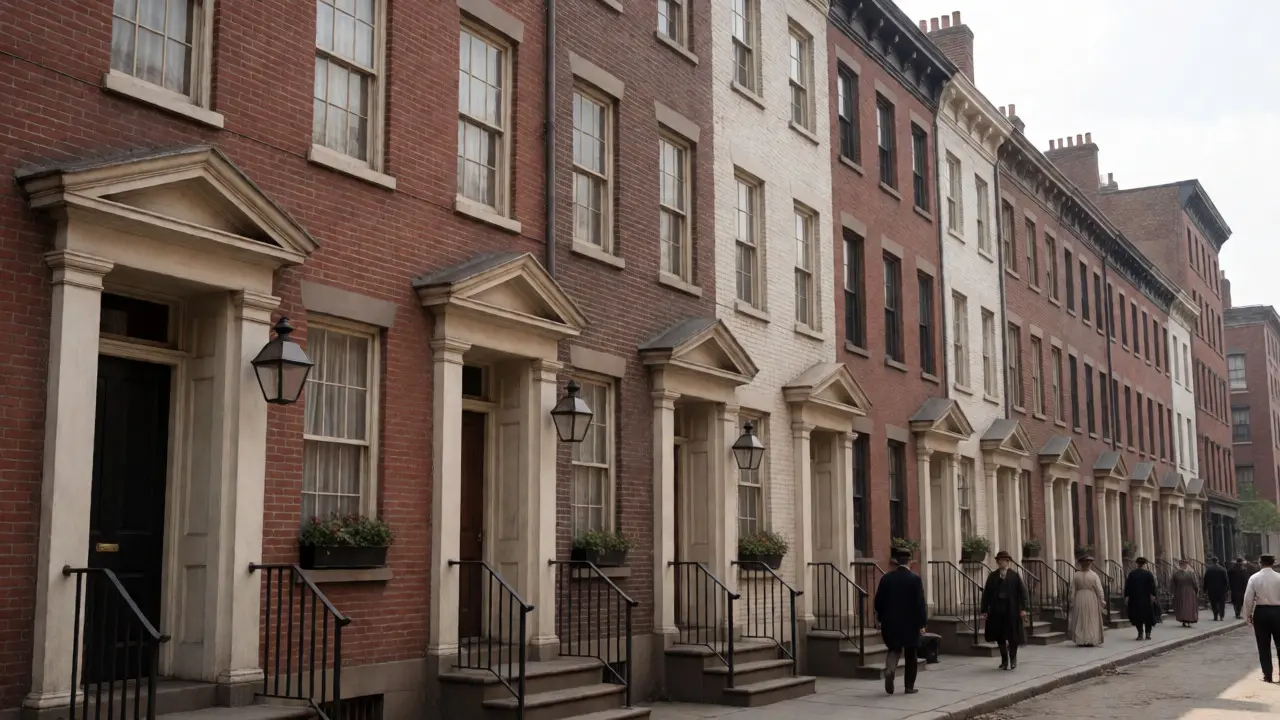
But look north, and you’ll find it everywhere. In New York City, entire blocks were rebuilt in this style. Row houses got fake fronts-wooden facades applied to brick buildings to make them look like temples. This was the original "fixer-upper" trend. Homeowners didn’t want to tear down their Federal-style bricks; they just slapped a wooden pediment on the front. It was cheap, effective, and trendy.
In smaller towns, the style appeared in churches and town halls. The logic was consistent: if government buildings looked like temples, citizens might feel more inspired to participate in democracy. It worked. The aesthetic became so dominant that even vernacular farmhouses adopted the shape, scaling down the grandeur but keeping the silhouette.
Why Did It Fade Away?
By the 1860s, Greek Revival was dying. What killed it? Two things: the Civil War and changing tastes.
The war shattered the idealistic view of the antebellum era. The optimism that fueled the desire for perfect democratic symbols felt naive after the bloodshed. Simultaneously, new materials and technologies emerged. Cast iron allowed for lighter, more delicate structures. Railroads brought access to diverse global influences. People grew tired of the rigid, boxy shapes of Greek temples. They wanted variety. They wanted color. They wanted the asymmetry of the Gothic Revival or the playful complexity of the Second Empire style.
Yet, the legacy remains. Look at any major US Supreme Court building, or even many university lecture halls. The vocabulary of Greek Revival never truly disappeared; it just became the background noise of institutional authority. We still equate columns with trust and stability, largely because this movement spent thirty years hammering that association into our collective psyche.
Living With History: Restoration Tips
If you own a Greek Revival home, you have a unique challenge. These buildings were often constructed with specific proportions that modern renovations tend to ruin. Here is how to keep the integrity intact without living in a museum.
- Respect the Porch: Never enclose the front porch unless absolutely necessary. The open space between the columns is crucial to the temple effect. Adding glass windows there kills the illusion of depth.
- Paint Colors Matter: While many are painted bright white, historical accuracy suggests softer off-whites or creams. True bright white was rare due to the limitations of lime wash. Check local historical guidelines before picking a paint chip.
- Window Placement: Windows should align vertically with the columns below them. Misaligned windows break the geometric rhythm that defines the style.
- Avoid Modern Clutter: Keep exterior lighting simple. Lantern-style fixtures work better than modern LED floodlights, which can flatten the dramatic shadows intended by the deep eaves.
Remember, the charm lies in the restraint. Don’t add Victorian gingerbread trim to a Greek Revival house. It’s like putting a tuxedo jacket on a cowboy. The two aesthetics clash fundamentally.
Is Greek Revival architecture the same as Neoclassical?
No, though they are related. Neoclassical is a broader term covering revivals of both Greek and Roman styles. Greek Revival specifically mimics ancient Greek temples, using straight lintels and post-and-lintel construction. Roman-influenced Neoclassical styles often use arches, domes, and vaults, which are absent in strict Greek Revival designs.
Why are Greek Revival houses usually painted white?
The white color mimics the appearance of marble, the primary material of ancient Greek temples. Since most American builders used wood or stucco, painting them white helped simulate the expensive stone look of antiquity. It also highlighted the sharp shadows and clean lines of the design.
What is the difference between a temple front and a full temple?
A "full temple" has columns surrounding the entire structure, like the Parthenon. A "temple front" only has columns on the facade facing the street. Most American Greek Revival buildings are temple fronts because wrapping columns around the whole house was too expensive and impractical for residential use.
Did Greek Revival architecture exist outside the United States?
Yes, particularly in Britain and Northern Europe during the late 18th and early 19th centuries. However, the American version is distinct because it was applied more widely to domestic and commercial buildings, not just monuments, reflecting the democratic ethos of the new republic.
How can I tell if my house is Greek Revival or Federal?
Look at the roofline and entrance. Federal houses have the long side facing the street with a central door and small sidelights. Greek Revival houses have the short end (gable end) facing the street, often with a prominent pediment and large columns. If you see a triangular peak above the door, it’s likely Greek Revival.