Deconstructivism in Architecture: How Broken Forms Transform Modern Spaces
 May, 30 2026
Have you ever walked into a building that felt like it was collapsing, yet somehow stood firm? That unsettling mix of chaos and stability is the signature of Deconstructivism, an architectural movement that challenges traditional notions of symmetry, continuity, and harmony by fragmenting structures into disjointed, unpredictable forms. Unlike classical architecture, which seeks balance and order, this style embraces disorder to create spaces that provoke thought and emotion. It’s not just about looking weird; it’s about breaking rules to redefine how we experience space.
What Is Deconstructivism in Architecture?
At its core, deconstructivism is a reaction against the rigid logic of modernism. Emerging in the late 1980s, it draws inspiration from the philosophical concept of deconstruction, popularized by Jacques Derrida. In architecture, this means taking familiar elements-walls, roofs, columns-and twisting them out of their expected positions. The result is a structure that looks like it’s in motion or falling apart, even though it’s engineered to be stable.
This style doesn’t follow a single set of rules. Instead, it encourages architects to question assumptions about form and function. Buildings might feature skewed angles, non-rectilinear shapes, and surfaces that appear to collide rather than connect. Think of it as visual noise turned into art. The goal isn’t confusion for its own sake but to challenge viewers to see space differently.
| Feature | Description | Example |
|---|---|---|
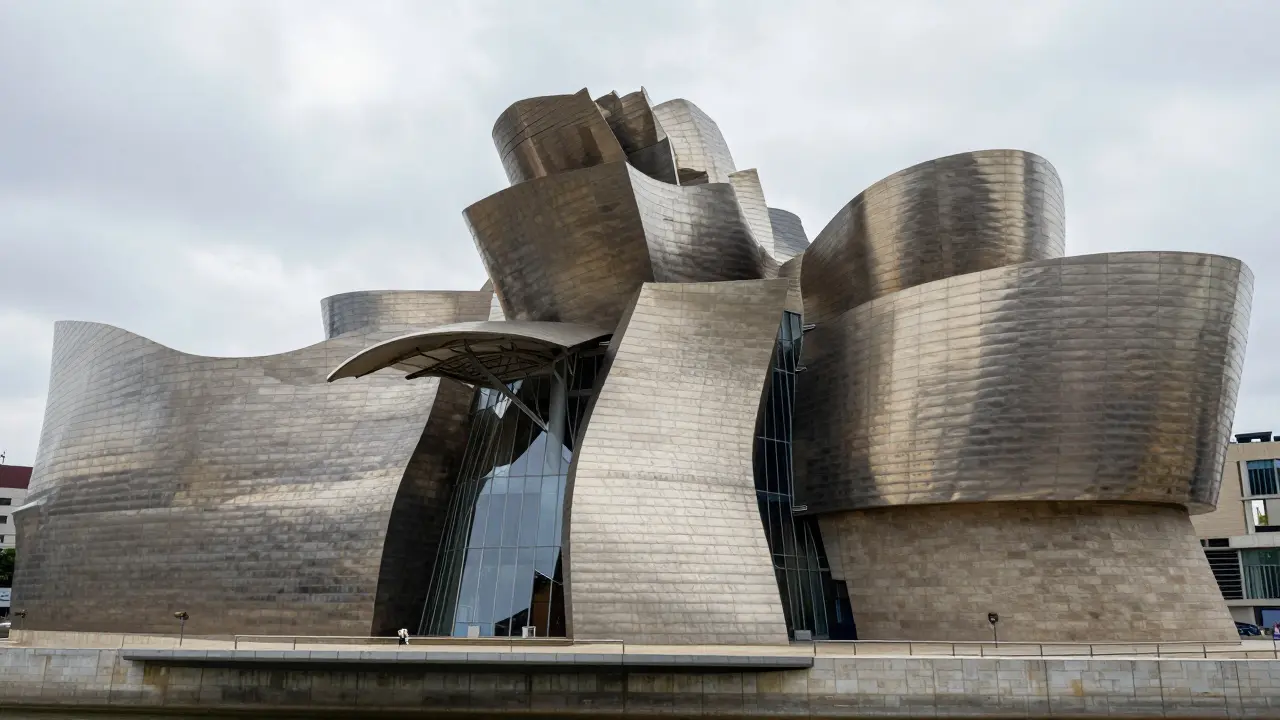
| Fragmentation | Breaking whole forms into separate, disjointed parts | Guggenheim Museum Bilbao |
| Non-linear Geometry | Curves, twists, and irregular angles instead of straight lines | Heydar Aliyev Center |
| Controlled Chaos | Appearing random while maintaining structural integrity | Dancing House Prague |
| Material Contrast | Mixing steel, glass, concrete, and titanium for dramatic effect | Jewish Museum Berlin |
The Origins: From Philosophy to Building Sites
You can’t understand deconstructivism without touching on its intellectual roots. In 1988, Philip Johnson and Mark Wigley organized an exhibition at the Museum of Modern Art in New York called “Deconstructivist Architecture.” This event brought together seven architects whose work shared a common thread: rejecting conventional design principles. Among them were Frank Gehry, known for his sculptural approaches using materials like corrugated metal, Zaha Hadid, who pioneered fluid, dynamic forms through advanced digital modeling, and Daniel Libeskind, famous for creating emotionally charged spaces that reflect historical trauma.
These architects didn’t set out to start a movement. They were exploring new ways to express complexity in urban environments. Their work coincided with advances in computer-aided design (CAD) software, which allowed them to model complex geometries that would have been impossible to calculate by hand. This technological leap made deconstructivism feasible, turning theoretical ideas into tangible buildings.
Iconic Examples That Redefined Urban Landscapes
Let’s look at some real-world examples where deconstructivism transformed cities. First up is the Guggenheim Museum Bilbao, designed by Frank Gehry. Completed in 1997, this museum became a global symbol of cultural regeneration. Its titanium-clad curves mimic fish scales or ship hulls, reflecting the city’s maritime history. Locals initially resisted the project, fearing it wouldn’t fit the industrial landscape. Today, it attracts over one million visitors annually, proving that controversial designs can become economic engines.
Another standout is the Heydar Aliyev Center in Baku, Azerbaijan, created by Zaha Hadid. Finished in 2012, this center features seamless white surfaces that flow into each other without sharp edges. It represents national identity through fluidity, contrasting with Soviet-era brutalism nearby. The building uses parametric design techniques, allowing engineers to optimize every curve for both aesthetics and structural efficiency.
In Berlin, Daniel Libeskind’s Jewish Museum tells a story through absence. Opened in 2001, its zigzagging plan includes empty corridors called “Void Spaces” that represent loss and memory. Visitors navigate narrow passages lined with rough concrete, feeling disoriented intentionally. This emotional impact shows how deconstructivism goes beyond visuals-it shapes experiences.
How Deconstructivism Changes Our Experience of Space
Walking through a deconstructivist building feels different because your brain expects certain patterns. When those expectations are broken, you pay closer attention. For instance, tilted floors force you to adjust your posture, making you aware of your body in relation to the environment. Angled walls disrupt sightlines, encouraging exploration rather than passive observation.
This approach also affects lighting and acoustics. Irregular surfaces scatter light unpredictably, creating shifting shadows throughout the day. Sound behaves similarly, bouncing off uneven planes to produce unique reverberations. These effects turn ordinary activities-like reading or talking-into multisensory events.
- Spatial Disorientation: Deliberately confusing layouts prompt users to engage actively with the space.
- Emotional Resonance: Jagged forms evoke tension or excitement, connecting architecture to human feelings.
- Visual Dynamism: Changing perspectives reveal new details as you move, keeping interest high.
Criticism and Controversy Surrounding the Style
Not everyone loves deconstructivism. Critics argue that these buildings prioritize style over substance. Some claim they’re too expensive to build, relying on custom components that drive up costs. Others say they ignore context, clashing with surrounding neighborhoods instead of blending in. Take the Dancing House in Prague, nicknamed “Fred and Ginger” after its two towers resemble dancing figures. While iconic, locals complained it disrupted the historic skyline along the Vltava River.
There’s also debate about accessibility. Steep ramps, narrow doorways, and irregular floor plans can pose challenges for people with mobility issues. Architects must balance artistic vision with practical needs, ensuring inclusivity without compromising design intent. Despite criticism, proponents believe these projects push boundaries, inspiring future innovations.
The Role of Technology in Making Deconstructivism Possible
Without modern tools, deconstructivism wouldn’t exist as we know it. Traditional drafting methods couldn’t handle the math behind curved surfaces or intersecting volumes. Enter computational design platforms like Rhino 3D and Grasshopper, which enable architects to simulate stress loads, test material combinations, and visualize outcomes before construction begins.
Robotics play a part too. Prefabricated panels cut precisely by CNC machines ensure accuracy during assembly. At the Louvre Abu Dhabi, robotic arms helped install thousands of interlocking aluminum stars forming the dome pattern. Such precision reduces waste and speeds up timelines, offsetting higher initial expenses.
- Model complex geometry digitally using CAD/BIM software.
- Analyze structural performance via finite element analysis.
- Manufacture components off-site with automated machinery.
- Assemble pieces on location following exact specifications.
Is Deconstructivism Sustainable?
Sustainability concerns often arise when discussing avant-garde architecture. Custom shapes mean less standardization, potentially increasing energy consumption during production. However, many deconstructivist projects incorporate green strategies. Solar panels integrated into facades generate renewable power. Green roofs reduce heat island effects. Recycled materials minimize environmental footprints.
Consider the Bloomberg Headquarters in London, designed by Foster + Partners. Though not purely deconstructivist, it shares traits like fragmented massing. The building captures rainwater, recycles air, and adjusts shading automatically based on sunlight intensity. By combining innovation with eco-friendly practices, such structures prove sustainability and experimentation aren’t mutually exclusive.
Future Directions: Where Does Deconstructivism Go Next?
As technology evolves, so does deconstructivism. Artificial intelligence now assists in generating设计方案 (design schemes), optimizing layouts for user behavior. Augmented reality lets clients walk through virtual models before breaking ground. Meanwhile, biomimicry influences forms inspired by natural processes-think honeycomb structures or leaf veins adapted for ventilation systems.
We may see more hybrid styles emerging, merging deconstructivism with minimalism or neo-brutalism. Younger architects experiment with temporary installations, testing concepts quickly without long-term commitments. Public participation grows stronger, inviting communities to co-create spaces that reflect local identities while embracing global trends.
Who started deconstructivism in architecture?
While no single person founded deconstructivism, key figures include Frank Gehry, Zaha Hadid, Daniel Libeskind, Peter Eisenman, Bernard Tschumi, Coop Himmelb(l)au, and Rem Koolhaas. Their collective work showcased during the 1988 MoMA exhibition defined the movement.
Why do deconstructivist buildings look chaotic?
They aim to challenge traditional aesthetics by introducing fragmentation, asymmetry, and distortion. This apparent chaos invites deeper engagement from viewers, prompting questions about order, meaning, and perception within built environments.
Are deconstructivist buildings safe?
Yes, despite their unconventional appearances, all deconstructivist structures undergo rigorous engineering tests to meet safety standards. Advanced simulations verify load-bearing capacities, wind resistance, and seismic stability prior to construction.
Can residential homes use deconstructivist design?
Absolutely! While large-scale public buildings dominate headlines, private residences also adopt deconstructivist principles. Smaller projects allow homeowners to personalize living spaces with bold geometric expressions tailored to individual tastes.
What makes deconstructivism different from postmodernism?
Postmodernism incorporates historical references humorously or ironically, whereas deconstructivism rejects nostalgia entirely. It focuses on abstract forms derived from mathematical algorithms rather than decorative motifs borrowed from past eras.