Byzantine Architecture: The Legacy of a World Heritage
 Jan, 24 2026
When you think of ancient architecture, you might picture the Parthenon or the Colosseum. But tucked away in Istanbul, Constantinople, and beyond, there’s a style that shaped the skyline of empires for over a thousand years - Byzantine architecture. It’s not just old buildings. It’s a revolution in how light, space, and faith came together to make people feel like they were standing inside heaven.
What Makes Byzantine Architecture Different?
Byzantine architecture didn’t just copy Roman styles - it transformed them. The Romans built with arches and vaults, but the Byzantines took it further. They figured out how to put a massive dome on top of a square building without it collapsing. That was a big deal. The secret? The pendentive - a curved triangular section that lets you transition from a square base to a circular dome. It’s like solving a 3D puzzle in stone and brick.
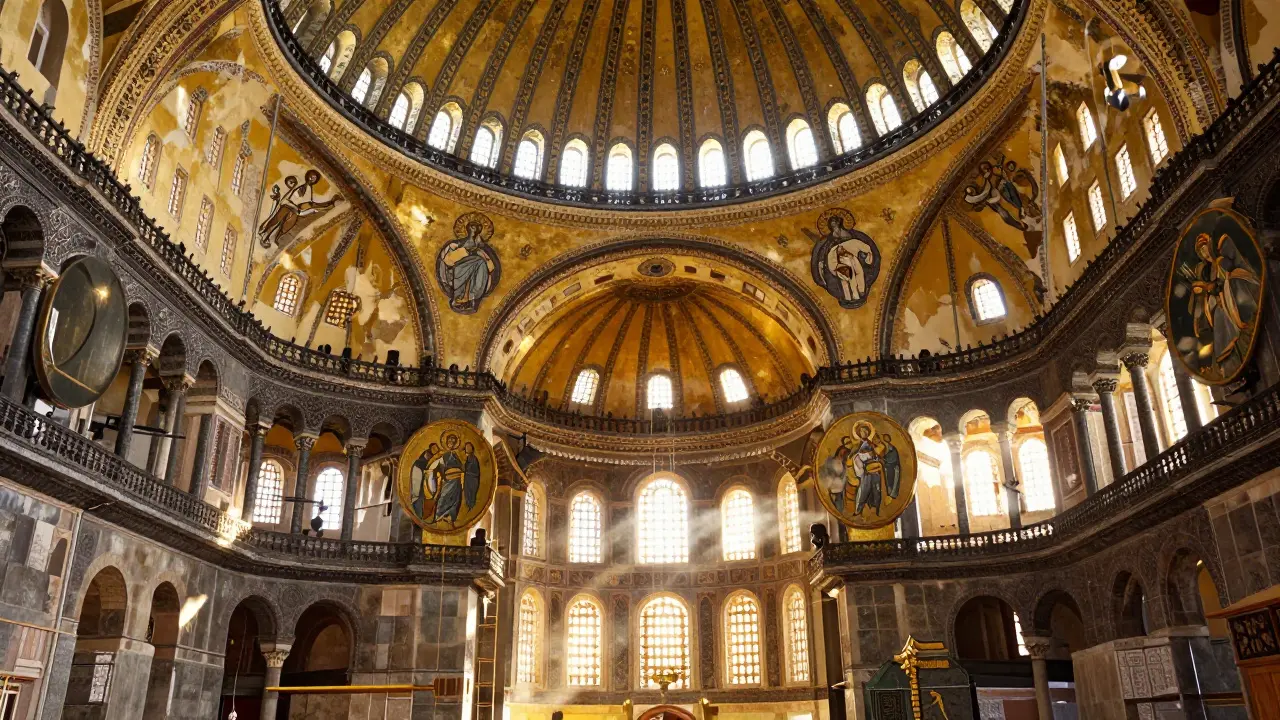
The most famous example? Hagia Sophia in Istanbul. Built in 537 AD under Emperor Justinian I, it held the title of the world’s largest cathedral for nearly a thousand years. Its dome is 31 meters across and seems to float above the nave, thanks to 40 windows around its base that flood the interior with light. That wasn’t just decoration. It was theology made visible - the dome represented heaven, and the light was divine presence.
Unlike Roman temples, which were meant to be admired from the outside, Byzantine churches were designed to be experienced from within. The walls were covered in gold mosaics. Figures of Christ, the Virgin Mary, and saints shimmered in candlelight. You didn’t just see the art - you felt it. The space itself became a spiritual tool.
The Spread of a Style Across Empires
Byzantine architecture didn’t stay in Constantinople. As the Eastern Roman Empire expanded, so did its style. From the monasteries of Mount Athos in Greece to the cathedrals of Venice and the churches of Kiev, you’ll find the same elements: domes, mosaics, centralized plans, and thick walls with small windows.
In Russia, Byzantine influence became the foundation of Orthodox church design. The onion domes you see in Moscow’s Red Square? They evolved from Byzantine hemispherical domes. St. Basil’s Cathedral may look wild with its colorful spires, but its core structure - the central dome surrounded by smaller ones - comes straight from Constantinople.
Even in Italy, the Venetians borrowed heavily. St. Mark’s Basilica in Venice looks like a copy of the Church of the Holy Apostles in Constantinople, which was destroyed in the 15th century. The five domes, the marble floors, the gold mosaics - it’s all Byzantine DNA.
Why did it spread so far? Because the Byzantine Empire wasn’t just a political power - it was a cultural engine. Its art, language, and architecture carried the weight of an official religion: Eastern Orthodoxy. When a new kingdom converted to Orthodoxy, it didn’t just adopt beliefs - it adopted buildings.
Materials and Techniques: How They Built the Impossible
Byzantine builders didn’t have modern cranes or concrete mixers. They worked with what they had: brick, stone, mortar, and a lot of patience. Bricks were lighter than stone, so they used them for domes and upper walls. Mortar was mixed with crushed pottery - a technique called opus mixtum - which made it stronger and more flexible.
The domes were built in stages. First, a wooden centering frame held the bricks in place as they dried. Then, once the mortar hardened, the frame was removed. The weight of the dome was transferred down through arches and piers to the ground. That’s why Byzantine churches have thick, heavy walls - they’re not just decorative. They’re structural.
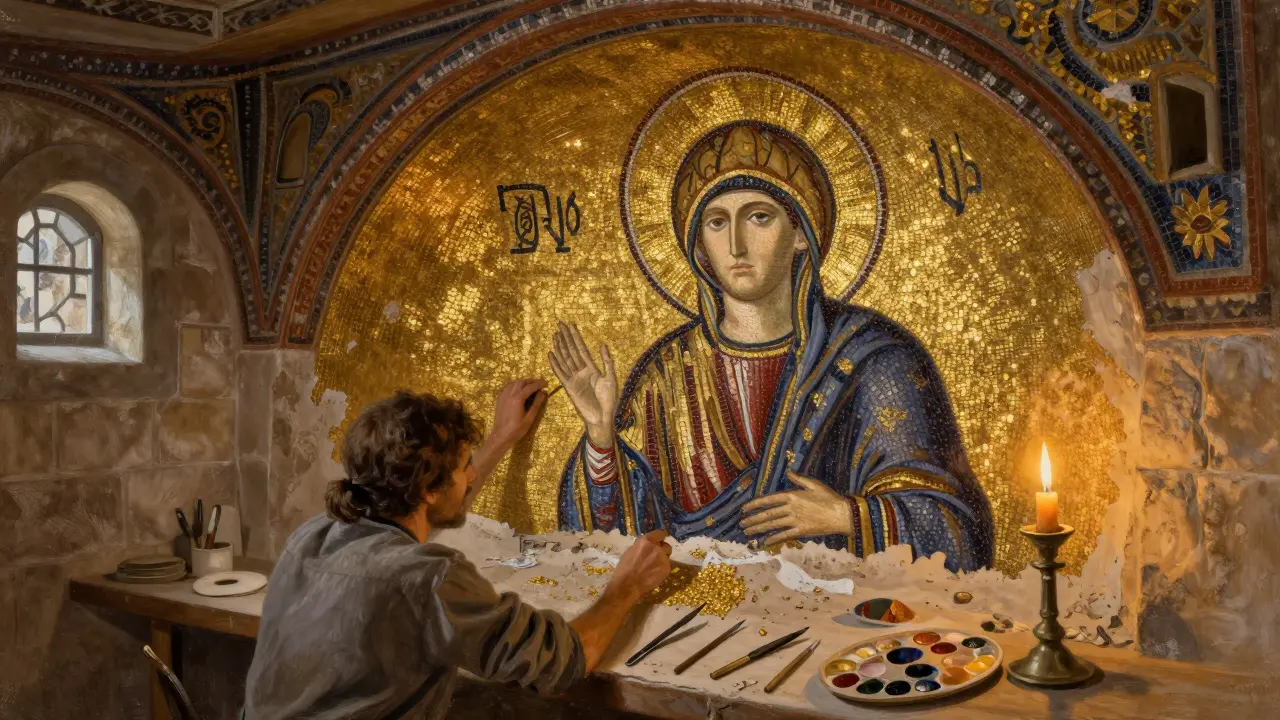
Inside, the walls were covered in thin tiles called tesserae. These were made of glass, gold leaf, and colored stone. Each piece was placed at a slight angle so that light would bounce off it differently depending on where you stood. That’s why mosaics seem to glow - they’re designed to move with the light.
There’s no other architecture that uses materials this way. The gold wasn’t just for show. It was meant to erase the boundary between earth and heaven. When you stood under that dome, you weren’t just looking at a painting - you were inside a vision.
Why It’s a World Heritage Site
In 1985, UNESCO named Hagia Sophia a World Heritage Site. But it’s not just one building. The entire Byzantine architectural tradition - from the churches of Thessaloniki to the ruins of Ravenna - is protected under that designation.
What makes it worthy? Three things: innovation, influence, and endurance.
First, the engineering. The dome of Hagia Sophia was the largest ever built until the Renaissance. It survived earthquakes, fires, and wars. It’s still standing after 1,500 years.
Second, its impact. Almost every Orthodox church built in Eastern Europe, the Balkans, and Russia for the next 800 years followed its blueprint. Even modern churches in places like Chicago or Toronto still use the centralized plan and dome because it works.
Third, its cultural weight. Byzantine architecture didn’t just house worship - it defined it. The layout of the church, the placement of the iconostasis, the way light fell on the altar - all of it was choreographed to guide the soul toward the divine.
That’s why UNESCO doesn’t just protect the stones. It protects the idea that architecture can be a vessel for belief.
Where to See the Best Examples Today
If you want to see Byzantine architecture at its peak, there are a few places you can’t miss:
- Hagia Sophia, Istanbul - The original masterpiece. Now a museum, it still holds its original mosaics, though some were covered during its time as a mosque.
- San Vitale, Ravenna, Italy - Famous for its stunning mosaics of Emperor Justinian and Empress Theodora. The octagonal shape and dome are pure Byzantine.
- Church of the Holy Apostles, Thessaloniki - One of the best-preserved Byzantine churches in Greece. Its brickwork and frescoes show the style in its prime.
- St. Mark’s Basilica, Venice - A direct copy of Constantinople’s lost Church of the Holy Apostles. The gold mosaics cover over 8,000 square feet.
- St. Sophia Cathedral, Kyiv - Built in the 11th century, it’s the oldest surviving Orthodox church in Ukraine. Its five domes and interior mosaics are nearly identical to those in Constantinople.
Each of these places isn’t just a tourist stop. They’re time capsules. You can walk into San Vitale and feel the same awe that a 6th-century worshipper felt.

The Legacy That Still Shapes Buildings Today
Byzantine architecture didn’t vanish with the fall of Constantinople in 1453. It lived on - quietly, powerfully.
Modern architects still use the dome as a symbol of authority and transcendence. The U.S. Capitol Building? Its dome is a direct descendant of Byzantine design. The same goes for many state capitols and courthouses across America. Even the dome of the British Museum’s reading room echoes the same principles of light and space.
In religious architecture, the Byzantine plan remains the standard for Orthodox churches worldwide. New churches built in Serbia, Romania, or even California still follow the same layout: narthex, nave, sanctuary, and dome. The materials may be concrete and steel now, but the intention hasn’t changed.
And in digital design? The idea of a central focal point - a glowing center surrounded by harmony - is still used in website layouts and app interfaces. It’s the same principle: draw the eye inward, create calm, and make the user feel guided.
Byzantine architecture didn’t just build churches. It built a way of seeing the world.
Why It Still Matters
Today, we build tall, sleek, glass towers. We use computers to design every curve. But we rarely build spaces that make you feel small in the best way - humbled, awed, connected to something bigger.
Byzantine architecture reminds us that buildings aren’t just shelters. They’re expressions of belief, power, and beauty. They’re meant to lift you up - not just physically, but spiritually.
When you stand under the dome of Hagia Sophia and the light spills down from above, you’re not just looking at an ancient building. You’re standing where emperors prayed, where artists poured their souls into gold, and where a civilization tried to make the divine visible.
That’s why it’s not just history. It’s still alive.
What is the most famous example of Byzantine architecture?
The most famous example is Hagia Sophia in Istanbul. Built in 537 AD under Emperor Justinian I, it was the largest cathedral in the world for nearly a thousand years. Its massive dome, surrounded by 40 windows that flood the interior with light, became the model for Orthodox churches across Europe and the Middle East. Today, it’s a museum and a UNESCO World Heritage Site.
What are the key features of Byzantine architecture?
Key features include large central domes supported by pendentives, thick walls with small windows, gold mosaics covering interior surfaces, centralized floor plans (often circular or octagonal), and the use of brick and lightweight materials for upper structures. The design focuses on creating a sense of divine light and spiritual elevation rather than exterior grandeur.
How did Byzantine architecture influence later styles?
Byzantine architecture directly shaped Orthodox church design across Eastern Europe and Russia, including the onion domes of Moscow. It also influenced Romanesque and early Gothic styles in Western Europe. Venice’s St. Mark’s Basilica is a direct copy of Constantinople’s lost Church of the Holy Apostles. Even modern government buildings, like the U.S. Capitol, borrow the dome structure from Byzantine prototypes.
Why did Byzantine builders use mosaics instead of paintings?
Mosaics were more durable than frescoes and reflected light better, making them ideal for dark, candle-lit interiors. Made from tiny pieces of glass and gold leaf, they shimmered in changing light, creating a sense of divine presence. The gold background symbolized heaven, and the figures appeared to float - a visual representation of the sacred.
Is Byzantine architecture still used today?
Yes. Orthodox churches built today - from Serbia to California - still follow the Byzantine plan: a central dome, iconostasis, and interior mosaics. Even secular buildings like courthouses and libraries use the dome to convey authority and solemnity. The style’s emphasis on light, space, and spiritual focus continues to influence modern design.