Bauhaus Style: A Revolution in Design and Architecture
 Mar, 9 2026
The Bauhaus style didn’t just change how buildings looked - it rewrote the rules of what design could be. Born in Germany in 1919, it wasn’t just an art school or a trend. It was a radical idea: that good design should be simple, honest, and available to everyone. No ornament for ornament’s sake. No luxury for the few. Just clean lines, honest materials, and form that followed function. And it spread - fast.
What Made Bauhaus Different?
Before Bauhaus, design was split. Architects built grand buildings with carved stone and gilded details. Artists made paintings and sculptures for galleries. Craftsmen made furniture and ceramics, but rarely talked to architects. Bauhaus smashed those walls. Walter Gropius, its founder, believed art and industry should work together. His school brought together painters, sculptors, carpenters, metalworkers, and weavers under one roof. They didn’t just teach technique - they taught a mindset.
Take the Bauhaus style is a design philosophy that combines simplicity, functionality, and geometric forms, originating from the Bauhaus school in Germany in 1919. Also known as Bauhaus design, it rejected decorative excess in favor of clean lines, primary colors, and industrial materials like steel, glass, and concrete.. You’ll see it in a chair with no legs - just a single curved piece of tubular steel holding up a leather seat. Or in a building with flat roofs, ribbon windows, and white walls. No moldings. No cornices. No fuss.
The Core Principles
There are five things every Bauhaus design shares:
- Form follows function. If something doesn’t serve a purpose, it shouldn’t exist. A chair isn’t for looking pretty - it’s for sitting. A window isn’t for decoration - it’s for light.
- Use real materials. Steel, glass, concrete, plywood. Not fake wood veneer or painted plaster. Let the material speak for itself.
- Geometry rules. Circles, squares, rectangles. No curves unless they’re needed. Think of a teapot shaped like a cube with a single handle - it’s not just stylish, it’s efficient.
- Mass production. Design shouldn’t be for the rich. If it can be made cheaply and well, it should be made for everyone. Bauhaus wanted to turn art into something you could buy at a store.
- Color with purpose. Red, blue, yellow. Black, white, gray. Primary colors weren’t just trendy - they were tools. They defined space, guided movement, and made things easier to see.
These weren’t just design rules - they were a social mission. Bauhaus believed better design could improve everyday life. A well-made lamp could help a worker read after a long shift. A simple, sturdy chair could be used in a factory, a school, or a home. It was democracy in design.
Iconic Bauhaus Examples
Some of the most famous designs from this era still live in homes today.
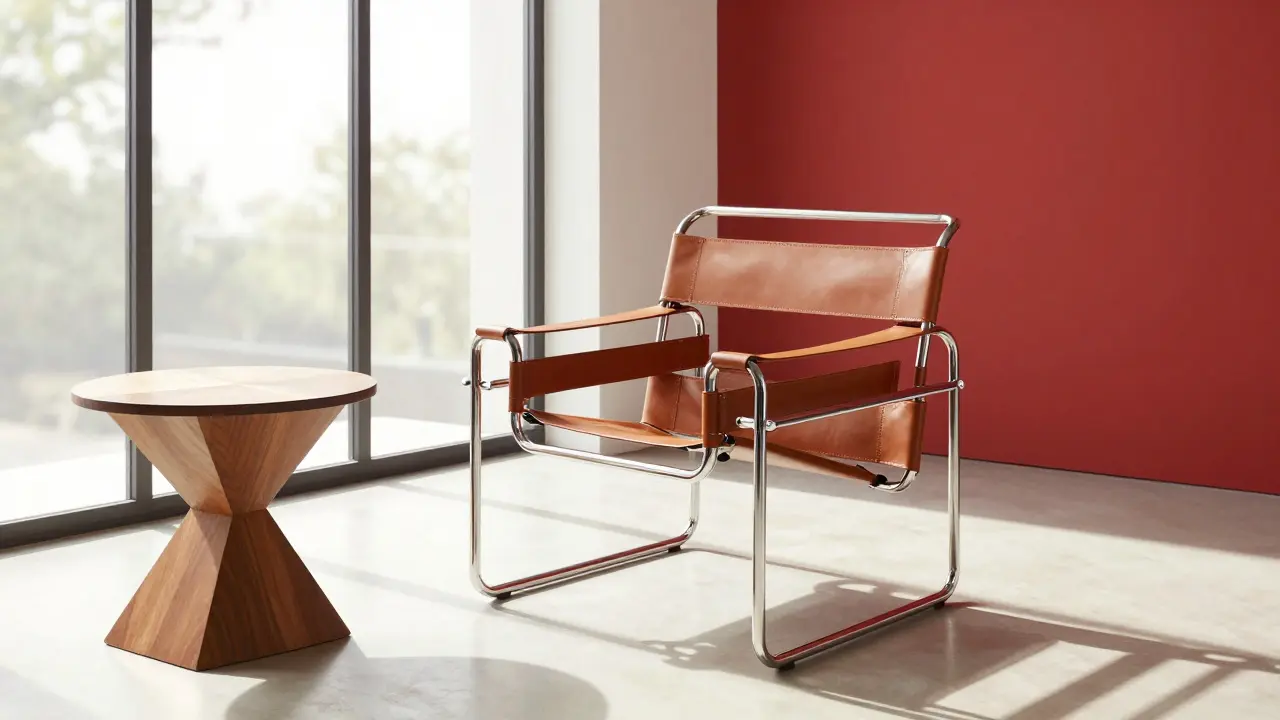
- The Wassily Chair - designed by Marcel Breuer in 1925. It looks like a skeleton of steel and leather. It was inspired by bicycle handlebars. Today, it’s still sold by IKEA and high-end furniture stores alike.
- The Barcelona Chair - Ludwig Mies van der Rohe’s masterpiece. Two curved steel frames holding a single leather cushion. It cost over $10,000 today, but it was meant to be mass-produced. It never was - but the idea stuck.
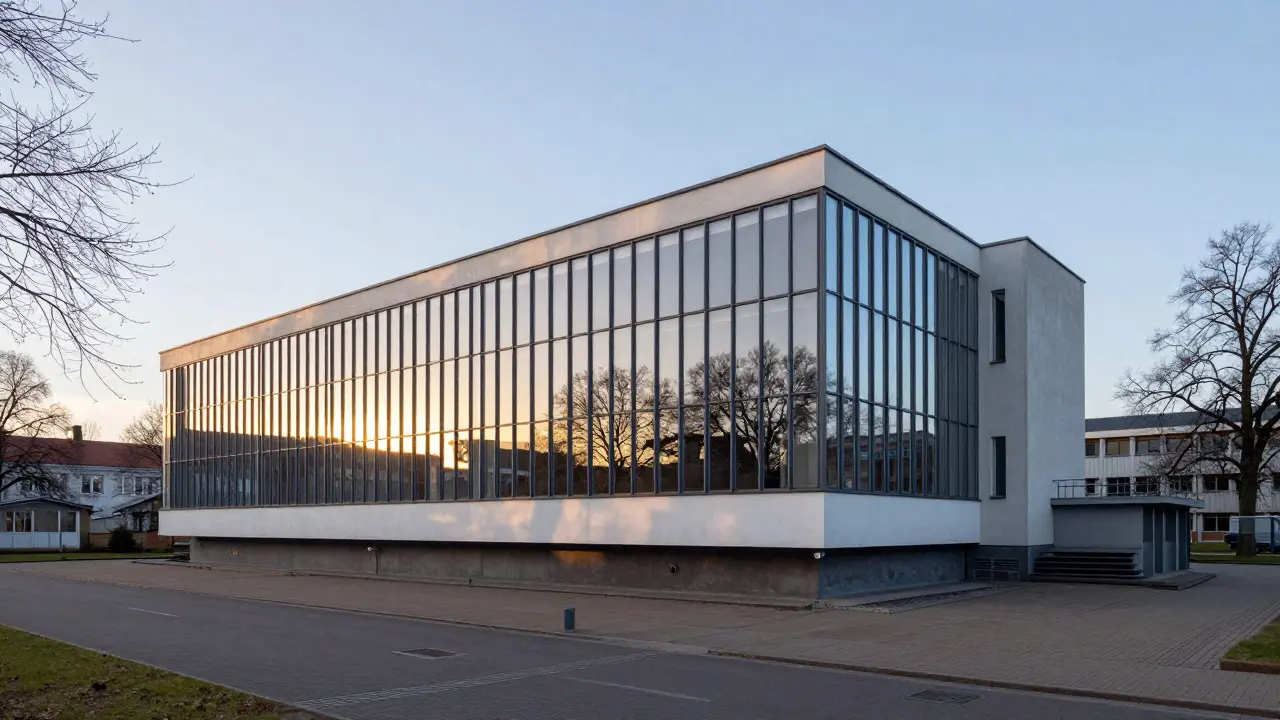
- The Bauhaus Building in Dessau - the school’s own home. Glass curtain walls, flat roof, asymmetrical layout. It looked like a machine for learning. People called it cold. Now, it’s a UNESCO World Heritage Site.
- Wassily Kandinsky’s paintings - yes, he taught at Bauhaus. His abstract compositions used shapes and colors like building blocks. He didn’t paint landscapes. He painted ideas.
These weren’t museum pieces. They were prototypes. People used them. Students sat on them. Workers used them in factories. They were meant to be lived with, not just admired.
How Bauhaus Changed the World
When the Nazis shut down the Bauhaus school in 1933, its teachers didn’t disappear. They fled - to the U.S., to Israel, to the UK. Gropius went to Harvard. Mies van der Rohe landed in Chicago. They brought the ideas with them.
Modernist architecture in the 1950s? That’s Bauhaus. The glass skyscrapers of New York? Bauhaus. The minimalist apartments in Tokyo? Bauhaus. Even Apple’s product design - the clean lines of the iPhone, the white walls of its stores - owes a debt to Bauhaus.
It didn’t just influence architecture. It changed how we think about kitchens, desks, light switches, even toothbrushes. The first electric kettle with a visible heating element? Bauhaus. The first modular shelving system? Bauhaus. The first wall-mounted radio? Bauhaus.
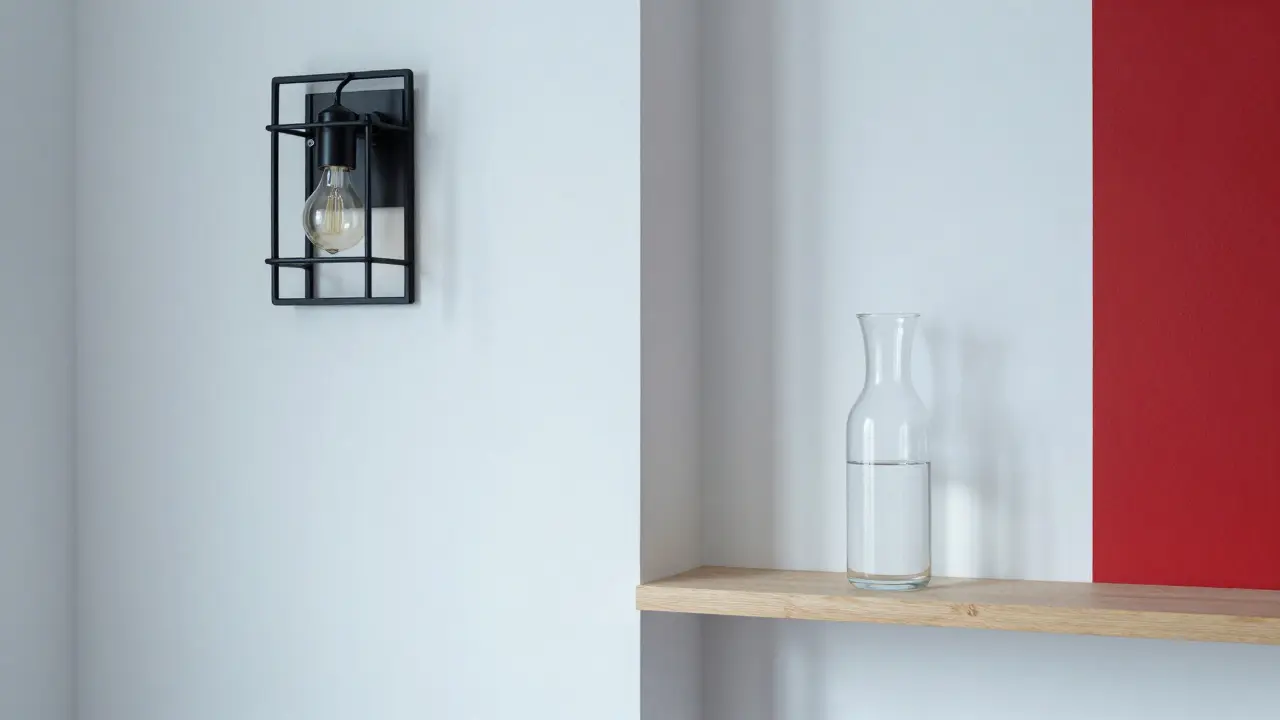
Today, you can walk into any IKEA store and see Bauhaus in action. The flat-pack bookshelf. The metal lamp. The glass water carafe. All of it traces back to Dessau, 100 years ago.
Why It Still Matters
Design today is full of noise. We have smart fridges that talk, sofas with built-in speakers, and apps that track how we sleep. But the best designs still feel quiet. They don’t shout. They just work.
Bauhaus taught us that beauty isn’t in decoration - it’s in clarity. In efficiency. In honesty. When you see a chair that doesn’t wobble, a light that doesn’t flicker, a door that opens smoothly - that’s Bauhaus.
It’s easy to forget, but Bauhaus was born during a time of chaos. Germany had just lost a war. The economy was in ruins. People were hungry. Instead of building monuments to power, the Bauhaus builders asked: How do we make life better? How do we give people dignity through design?
That’s why it still matters. In a world of clutter, it reminds us that less isn’t just trendy - it’s thoughtful. That a well-made object doesn’t need to cost a fortune. That design isn’t about status - it’s about service.
Where to See Bauhaus Today
You don’t need to fly to Germany to feel it. Walk into any modern apartment building with floor-to-ceiling windows. Look at the metal-framed chairs in your local café. Check out the white, unadorned walls of a hospital waiting room. That’s Bauhaus.
And if you want to see it in person? The Bauhaus Archive is a museum in Berlin dedicated to preserving and exhibiting the history and legacy of the Bauhaus movement. in Berlin holds the largest collection. The Bauhaus Dessau is the original school building, restored and now functioning as a museum and cultural center. in Dessau still operates as a museum and event space. Even in New Zealand, you’ll find Bauhaus echoes - in the clean lines of Wellington’s modernist public buildings, or in the minimalist interiors of local design studios.
Common Misconceptions
People think Bauhaus means ‘cold’ or ‘sterile.’ It doesn’t. It means precise. Intentional. Human-centered.
It’s not anti-decorative - it’s pro-purpose. A red wall isn’t just bold. It’s a way to define a space. A curved edge isn’t just stylish - it’s safer for children. A hidden hinge isn’t just sleek - it’s easier to clean.
And it’s not just for architects. You don’t need to be a designer to use Bauhaus. Try it at home: remove one unnecessary item from your shelf. Choose a lamp that shows its bulb, not hides it. Buy a chair that’s made of one material, not three fake ones.
Bauhaus isn’t a style you buy. It’s a way of thinking you live.
Is Bauhaus style still relevant today?
Yes - more than ever. Modern minimalism, Scandinavian design, and even tech product aesthetics all draw from Bauhaus principles. Apple’s product lines, IKEA’s furniture, and the layout of most smartphone interfaces owe their clarity and simplicity to Bauhaus. It’s not a relic - it’s the foundation of how we design things today.
What materials are typical in Bauhaus design?
Bauhaus embraced industrial materials: tubular steel, reinforced concrete, glass, plywood, and leather. These weren’t chosen for their luxury, but for their honesty and function. Steel could be bent into strong, lightweight frames. Glass let in light and created open spaces. Plywood was cheap, durable, and could be molded into curves. The goal was to use what worked, not what looked expensive.
Did Bauhaus only focus on architecture?
No. While architecture is what most people remember, Bauhaus began as a school for art, craft, and industry. Its workshops included metalworking, weaving, typography, furniture design, and even stage design. Artists like László Moholy-Nagy and Oskar Schlemmer experimented with light, motion, and typography. The school believed design should touch every part of daily life - from a teacup to a city plan.
Why did the Nazis shut down Bauhaus?
The Nazi regime saw Bauhaus as ‘degenerate’ and ‘un-German.’ Its international, modernist style clashed with their ideal of traditional, ornate architecture. They also disliked its socialist leanings - the school welcomed students of all backgrounds and believed design should serve the public, not the elite. In 1933, under political pressure, the school was forced to close.
Can I incorporate Bauhaus style into my home without going full minimalist?
Absolutely. You don’t need to strip your home bare. Start with one piece - a steel-framed chair, a glass lamp, a white wall with a single red accent. Focus on function: choose furniture that’s sturdy, not decorative. Avoid clutter. Let light in. Use color intentionally, not randomly. Even one Bauhaus-inspired element can bring clarity and calm to a space.
Next Steps
If you’re drawn to Bauhaus, start small. Visit a local furniture store and look for pieces with clean lines and no unnecessary details. Ask yourself: What does this object actually do? Is every part necessary? Could it be made simpler?
Try redesigning one corner of your home. Remove one thing you don’t use. Replace a cluttered lamp with one that shows its bulb. Choose a single bold color for a wall - red, blue, or black. You’re not decorating. You’re thinking.
Bauhaus didn’t ask for perfection. It asked for intention. And that’s something anyone can practice - today, in any home, anywhere in the world.