A Beginner's Guide to Functionalism in Sociology
 Jan, 31 2026
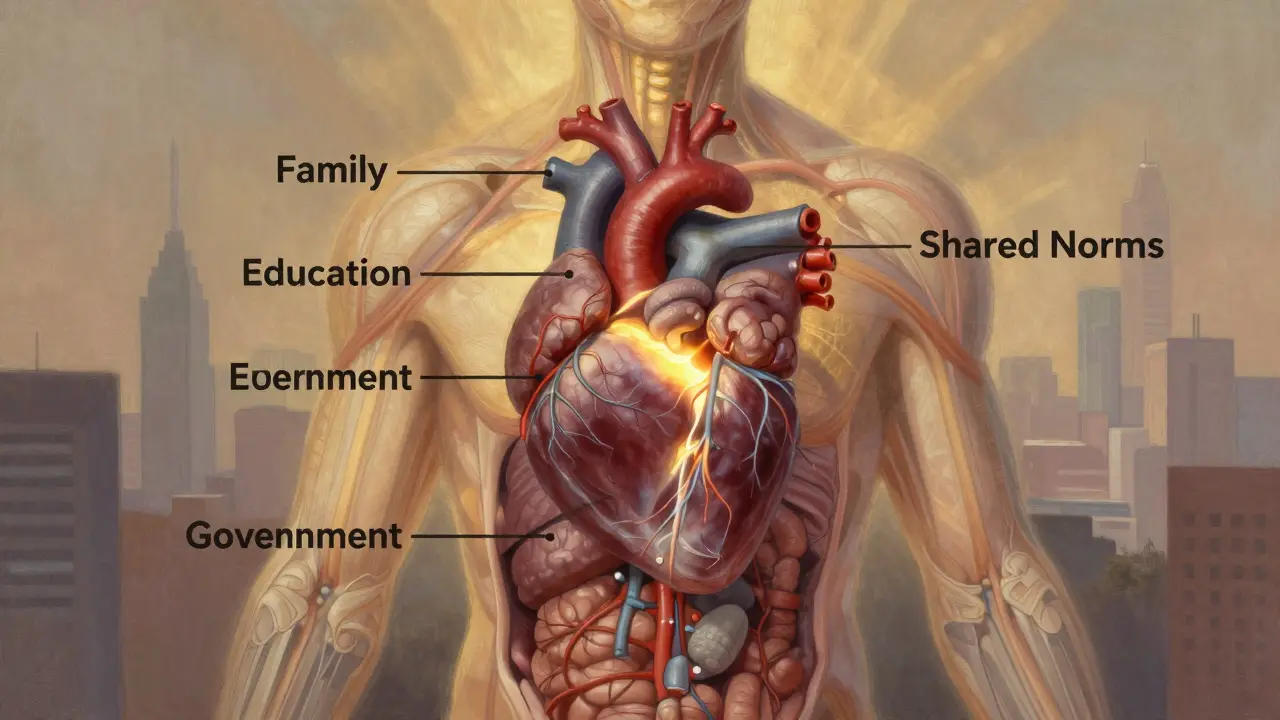
Ever wonder why societies don’t just fall apart? Why do people follow rules, go to work, or even get married? Functionalism in sociology gives you a simple, powerful way to understand that. It’s not about blaming individuals or pointing fingers at power structures. Instead, it asks: what purpose does this part of society serve? Think of society like a living body. The heart pumps blood. The lungs breathe. The brain coordinates. If one part fails, the whole system struggles. Functionalism says the same thing about schools, families, religion, and laws-they all keep society running.
What Is Functionalism?
Functionalism is a theory that sees society as a complex system made up of interconnected parts, each contributing to overall stability. It emerged in the late 1800s, mostly through the work of French sociologist Emile Durkheim a foundational figure in sociology who argued that social facts-like laws, norms, and institutions-exist outside individuals and shape their behavior. Durkheim didn’t just study crime or religion for their own sake. He wanted to know how they helped society hold together.
Imagine a small town where everyone goes to church on Sunday. Functionalism wouldn’t ask if people believe in God. It would ask: what does this shared ritual do? Maybe it brings people together. Maybe it reinforces shared values. Maybe it gives people a sense of belonging. That’s the core idea: social practices exist because they function-they meet a need.
Later thinkers like Talcott Parsons an American sociologist who expanded Durkheim’s ideas into a comprehensive theory of social systems, emphasizing how institutions maintain equilibrium and Robert Merton a U.S. sociologist who introduced the concepts of manifest and latent functions, distinguishing between intended and unintended consequences of social behavior built on this. Parsons called society a “system of action,” where every role and institution fits into a larger pattern. Merton added nuance: not everything has a good purpose. Some things just happen by accident.
How Functionalism Explains Social Institutions
Functionalism doesn’t just talk in generalities. It looks at real parts of society and asks: what’s their job?
- Family: It teaches children norms, provides emotional support, and ensures the next generation is raised. Without families, who would socialize kids? Who would care for the elderly?
- Education: Schools don’t just teach math and reading. They teach punctuality, teamwork, respect for authority, and how to follow rules-all skills needed in the workplace. Durkheim saw education as a way to create social solidarity.
- Religion: Whether it’s church, mosque, or temple, religion gives people meaning, connects them to something bigger, and creates shared rituals. It helps reduce anxiety about death, injustice, or chaos.
- Law and Government: Laws aren’t just about punishment. They set boundaries, protect property, and make interactions predictable. Without them, trust breaks down. People stop cooperating.
- Healthcare: Hospitals don’t just treat illness. They keep the workforce healthy. A sick population can’t produce goods, pay taxes, or raise children. Healthy people = stable society.
Each of these institutions isn’t random. They evolved because they solved problems. The family structure changed over time, sure-but the function of care and socialization stayed.
Manifest vs. Latent Functions
Not everything in society works the way people think it does. That’s where Robert Merton’s idea of manifest and latent functions comes in.
Manifest functions are the obvious, intended outcomes. For example, the manifest function of college is to give you knowledge and a degree so you can get a job.
Latent functions are the hidden, unintended side effects. College also helps you build a social network. It delays entry into the job market. It creates a shared cultural experience between generations. These aren’t why most people go to college-but they still matter.
Think about social media. Its manifest function? Connecting people. Its latent function? Creating new forms of social pressure, spreading misinformation, or even making people feel lonelier because they compare their lives to curated posts. Functionalism doesn’t judge. It just observes: what’s happening? What’s being maintained?

Criticism of Functionalism
Functionalism isn’t perfect. Critics say it’s too focused on order and stability. It ignores conflict, inequality, and change.
Take gender roles. Functionalism might say: women stay home to care for kids because that’s what keeps families stable. But what about women who want careers? What about families where men stay home? Functionalism doesn’t ask why some people are left out. It assumes everyone benefits from the system.
Marxists call functionalism a “consensus theory”-it paints society as harmonious, when in reality, power is uneven. The rich benefit from education systems that favor their kids. The poor get stuck in low-wage jobs because the system isn’t designed to help them rise.
And what about social change? Functionalism struggles to explain revolutions, protests, or movements like #MeToo. If everything serves a function, why do people fight to change things? Functionalism can’t easily explain why the system sometimes breaks.
Still, functionalism isn’t wrong-it’s just incomplete. It’s like looking at a clock and only seeing the gears turn. You miss the person who built it, the person who broke it, and the person who wants to replace it.
Why Functionalism Still Matters Today
Even with its flaws, functionalism gives you a practical lens. When you see a new policy-like mandatory school uniforms, or banning plastic bags-you can ask: what problem is this trying to fix?
In New Zealand, for example, the government introduced free school lunches in low-income areas. Functionalism would ask: what’s the function? Is it to improve health? Reduce hunger? Increase attendance? Improve learning outcomes? All of those are valid. But the deeper function might be to reduce inequality’s impact on future generations. It’s not just about food-it’s about keeping society stable by preventing the next wave of disadvantage.
Functionalism also helps explain why some traditions stick around even when they seem outdated. Why do we still have graduation ceremonies? Why do we celebrate national holidays? Because they reinforce identity and unity. Even if you don’t believe in the flag, the ritual matters.
It’s also useful in public health. When a disease spreads, officials don’t just treat patients-they tell people to wash hands, wear masks, or stay home. Functionalism helps you see these aren’t just medical rules. They’re social tools to maintain order during crisis.

Functionalism vs. Other Theories
Functionalism isn’t the only way to look at society. Here’s how it compares:
| Aspect | Functionalism | Conflict Theory | Symbolic Interactionism |
|---|---|---|---|
| Focus | Stability, order, shared values | Power, inequality, struggle | Everyday interactions, meanings |
| Key Thinker | Emile Durkheim | Karl Marx | George Herbert Mead |
| Big Question | What keeps society together? | Who benefits? Who gets left out? | How do people create meaning in daily life? |
| View of Change | Slow, evolutionary | Driven by conflict | Constant, through interaction |
| Strength | Explains social cohesion | Exposes inequality | Explains personal experience |
Functionalism answers “why society holds together.” Conflict theory answers “why it’s unfair.” Symbolic interactionism answers “how people live it every day.” You don’t have to pick one. Real understanding comes from using them all.
How to Use Functionalism in Everyday Life
You don’t need a sociology degree to think like a functionalist. Next time you see something strange in society, ask:
- What’s the obvious purpose of this?
- What’s the hidden effect?
- Who benefits? Who might be harmed?
- What would happen if this disappeared?
For example, why do we have traffic lights? Obvious purpose: prevent crashes. Hidden effect: creates predictable behavior, reduces stress, reinforces obedience to rules. If they vanished, chaos. But what if they were only in rich neighborhoods? Then the function isn’t equal. That’s where functionalism meets conflict theory.
Or think about TikTok. Obvious purpose: entertainment. Hidden effect: reshaping attention spans, creating new forms of identity, turning hobbies into jobs. The function isn’t just fun-it’s economic and psychological.
Functionalism turns ordinary things into puzzles. And once you start seeing the hidden roles, you start seeing society differently.
Is functionalism still relevant today?
Yes. Even though it’s old, functionalism helps explain why institutions like schools, families, and governments still exist the way they do. It’s especially useful when studying public health, education policy, or social rituals. It doesn’t explain everything-but it explains the glue that holds things together.
Does functionalism ignore inequality?
Yes, that’s one of its biggest weaknesses. Functionalism assumes society works for everyone, but in reality, many groups-like women, Indigenous people, or low-income communities-don’t benefit equally. That’s why it’s often paired with conflict theory to get a fuller picture.
Can functionalism explain social movements like climate activism?
Not well on its own. Functionalism would ask: what function does climate activism serve? Maybe it pushes governments to act, prevents collapse, or creates new norms around sustainability. But it doesn’t explain why people risk arrest or protest. For that, you need conflict theory or symbolic interactionism-why people feel angry, why they believe change is possible.
How is functionalism different from just common sense?
Common sense says, “People go to school to learn.” Functionalism says, “People go to school to learn, but also to become predictable workers, to accept authority, and to bond with peers.” It digs deeper than surface reasons. It’s not just what people think-they do. It’s what society needs them to do.
Do all sociologists believe in functionalism?
No. Many modern sociologists see it as too passive. It doesn’t challenge power or explain change well. But it’s still taught because it’s the easiest way to understand how society holds together. Most sociologists use it as a starting point, then add other theories.
Where to Go From Here
Functionalism is a foundation. Once you understand how society keeps itself running, you can ask better questions. Read Durkheim’s The Division of Labor in Society or Merton’s essays on manifest and latent functions. Watch how institutions adapt during crises-pandemics, wars, economic crashes. Notice what stays the same, and what breaks.
Sociology isn’t about memorizing theories. It’s about seeing the invisible threads that connect people. Functionalism gives you a pair of glasses for that. Put them on. Look around. And ask: what’s holding this together?